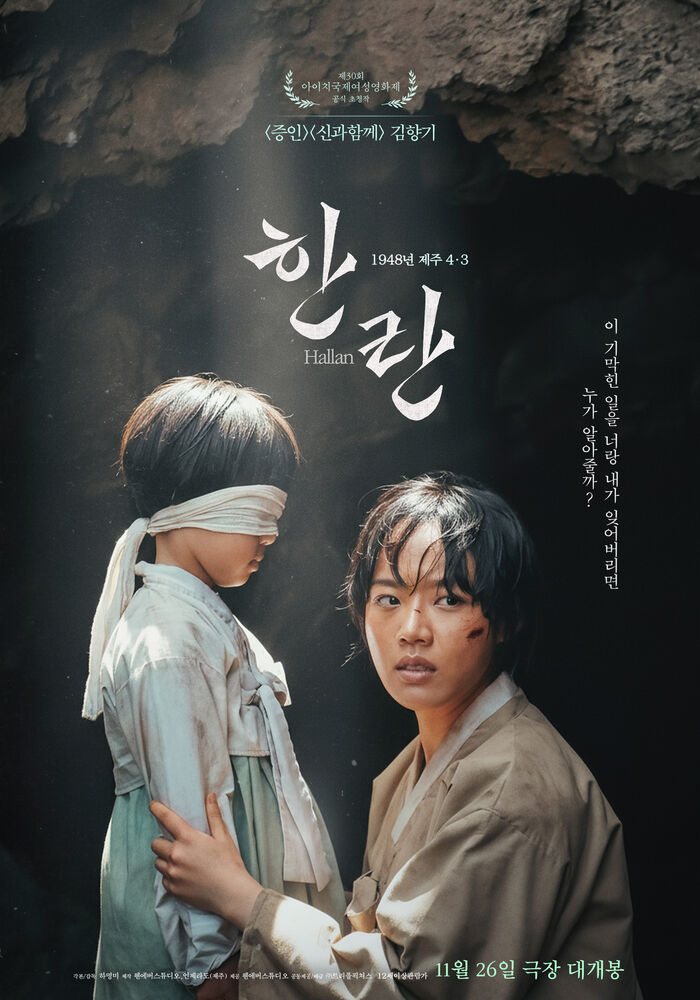
Director Ha Myung-mi’s feature "Hallan" held a special screening at South Korea’s National Assembly, drawing strong reactions from lawmakers and civilians alike.
Set against the Jeju April 3 Uprising (Jeju 4·3) of 1948, "Hallan" follows a mother and daughter’s fight to survive amid state violence, channeling resilience and the sanctity of life. The film has earned raves from critics and audiences since its release.
Grassroots support has fueled momentum: citizens and broadcasters have organized relay screenings to keep the Jeju 4·3 tragedy in public memory. Institutions have joined in as well, including a nationwide committee for Jeju 4·3, the Jeju 4·3 Peace Foundation (arranging group viewings for survivors and families), the Jeju Provincial Council, and groups spanning public servants, teachers, schools, social welfare centers, volunteer networks, local community organizations, and even military units―turning year-end and New Year gatherings into collective acts of remembrance.
On January 7 (Wed.) at 6 p.m., "Hallan" reached the National Assembly’s Members’ Office Building for a special screening hosted by Representatives Park Ji-won, Park Kyun-taek, Yang Bu-nam, and Jung Jin-uk.
Speaker Woo Won-shik, Democratic Party leader Jung Cheong-rae, Legislation and Judiciary Committee chair Choo Mi-ae, and Representatives Kim Young-hwan, Moon Dae-rim, Jung Jin-uk, and Jung Choon-saeng attended, along with Baek Kyung-jin of the Jeju 4·3 National Committee. Joined by citizens, children, teens, and college students, attendees reflected on the pain of Jeju 4·3 and the need to remember it.
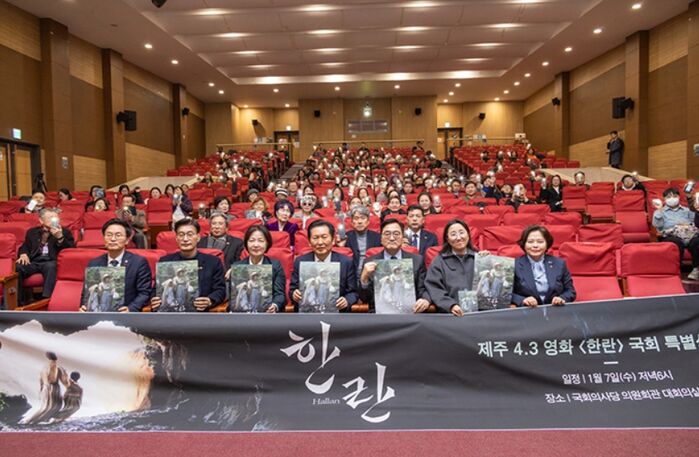
“Jeju 4·3 isn’t just a local tragedy―it’s a national one,” Speaker Woo said, calling it a dark chapter of Cold War-era state violence and civilian loss. “Culture has the power to move us from simply ‘knowing’ history to truly empathizing with it. I hope many―especially younger generations―see this film and reflect deeply on Jeju 4·3.”
Before his remarks, Democratic Party leader Jung Cheong-rae led attendees in “Namdo That Never Sleeps”, a protest anthem he said he first sang as a student activist. “Decades later, we’re still singing it,” he noted, adding that the pain symbolized by canola blossoms and the winter-blooming ‘"Hallan"’ orchid remains unresolved for many victims’ families.
"Hallan" opened on November 26 and is closing in on 30,000 admissions nationwide, buoyed by group and community screenings.
(SBS Entertainment News | Kim Ji-hye)