

A career-spanning video celebrating Lee Byung-hun’s filmography dropped on Vanity Fair’s official YouTube channel in early January, drawing fresh global attention to the Korean star.
Speaking in fluent English, Lee walks through the projects that shaped him―offering not just an actor’s evolution, but a snapshot of how Korean storytelling has broken through worldwide.
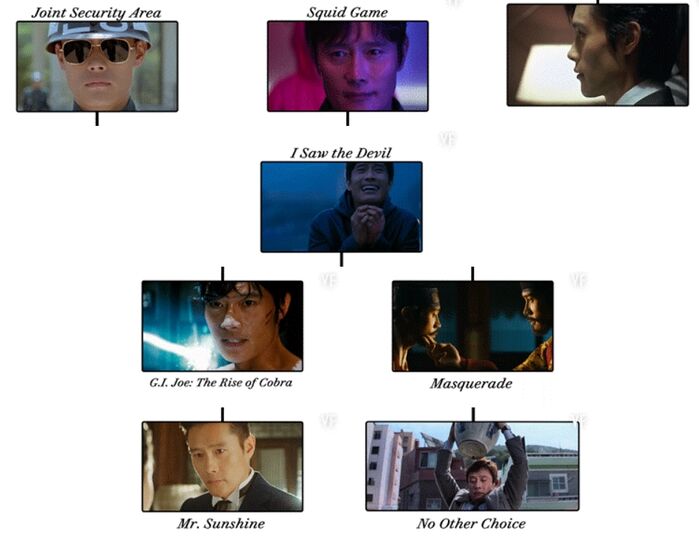
He points to "Joint Security Area" (2000) as a decisive turning point. “None of us expected much―we’d all had flops,” he recalls. “Then it became a record-breaking hit, got invited to the Berlin International Film Festival, and changed everything for all of us.” The film’s tragic tale, rooted in a divided Korea, still resonates today.
Another pivot came with Kim Jee-woon’s "A Bittersweet Life" (2005). Lee calls it “an action noir with a philosophical, artistic core.” Its Cannes berth put him on Hollywood’s radar, and an early connection with a U.S. agent opened the door to global opportunities.
"The Good, the Bad, the Weird" (2008) marked his first full-throttle turn as a villain. Nicknamed a “kimchi Western” for its genre-twisting flair, the film demanded punishing horseback and action work―what Lee calls one of the most grueling stretches of his career. The whirlwind across China and Hong Kong led straight into Hollywood via the "G.I. Joe" franchise.
"I Saw the Devil" (2010) proved both acclaimed and contentious. After deep discussions with director Kim Jee-woon, Lee helped reshape the ending to leave audiences with the hollow ache of loss rather than revenge. The film battled ratings hurdles for its intensity, but he still ranks it among his most accomplished works. Director Antoine Fuqua later cited the movie while casting "The Magnificent Seven" (2016), a sign that Lee’s performance crossed borders on its own power.
With "Masquerade" (2012), a 10-million-ticket phenomenon at home, Lee delivered a star turn in dual roles―balancing mass appeal with craft. He still treasures a London Korean Film Festival screening where his "RED 2" (2013) castmates Bruce Willis, Helen Mirren, and John Malkovich watched alongside him. "RED 2" also carries a personal tribute: a photo used on-screen and his late father’s name in the end credits. “It felt like sharing the Hollywood he loved most,” Lee says.
TV brought another global wave with "Mr. Sunshine" (2018). As Eugene Choi―born into bondage, remade in America, and belonging nowhere―Lee found his largest international fanbase via Netflix. “More people recognized me from that series than from Hollywood films,” he notes.
Then came "Squid Game" (2021-2025), where he played the enigmatic Front Man, channeling a bleak view of humanity and power. Revisiting the character season after season let him explore new layers. “I don’t think there will be a Season 4,” he says, “but a Front Man origin spinoff would be fascinating.”
Most recently, "No Other Choice" (2025) reunited Lee with Park Chan-wook after two decades. The film questions whether systems built to better our lives actually make us happier. As Mansu, a man both harmed by and complicit in that system, Lee delivers one of his most ironic and demanding performances. He calls it “one of the films I’m proudest of.”
With each risk expanding his range, all eyes are on what Lee chooses next. "No Other Choice," already released in the U.S., arrives on Netflix for Korean audiences starting today (the 28th).
(SBS Entertainment News | Kim Ji-hye)