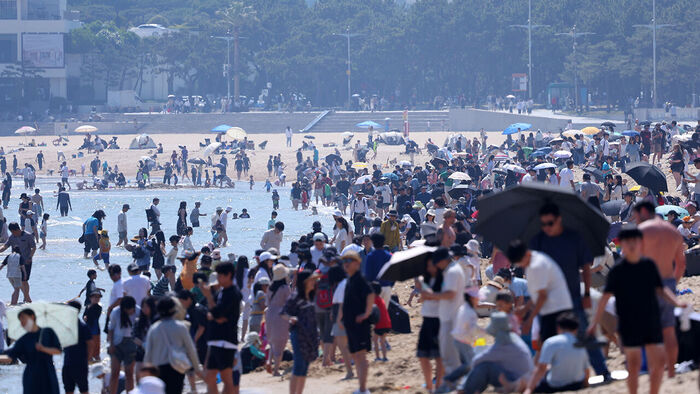
▲ Citizens cool off at Haeundae Beach in Busan on the afternoon of May 17, when daytime temperatures rose significantly nationwide, bringing hot weather.
This year's spring was recorded as the second warmest spring since 1973, when the meteorological observation network was expanded nationwide.
The Korea Meteorological Administration (KMA) announced that the nationwide average temperature for this spring, from March to May, was 13.3°C (56°F), which is 1.4°C (2.5°F) higher than the average spring temperature of 11.9°C (53°F).
The "direct reason" is that the country was under a high-pressure system, resulting in many clear days.
However, climate change is cited as the "fundamental cause," given that all but one of the top 10 warmest springs have occurred since 2010.
The warmest periods this past spring were late March, mid-April, and mid-May.
In particular, the nationwide average temperature in mid-May was 19.7°C (67°F), the highest on record for mid-May.
On May 16 in Gumi, North Gyeongsang Province; May 17 in Geochang, South Gyeongsang Province; and May 18 in Mungyeong, Andong, and Yeongcheon in North Gyeongsang Province, temperatures rose above 33°C (91°F), marking the earliest heatwaves since meteorological observations began in each region.
The seas surrounding the Korean Peninsula were also hot this past spring.
The sea surface temperature in the surrounding waters was 14.0°C (57°F), the second highest in the past 10 years, following 2024.
Due to the strong inflow of warm currents, such as the Tsushima Warm Current and the East Korea Warm Current, sea surface temperatures in March, April, and May were all higher than last year and the 10-year average.
Meanwhile, precipitation this past spring was 268.1 mm, similar to the average year.
(Photo: Yonhap News)
※ Please note: This article was translated by AI and may contain errors.