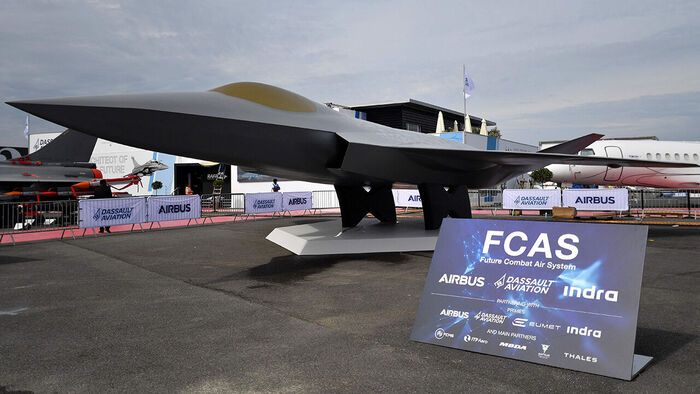
▲ A model of the European next-generation fighter jet
The joint development project for a next-generation fighter jet, pursued by France, Germany, and Spain, has collapsed following disputes over equity stakes and technical specifications, Reuters and dpa reported on June 8 (local time).
A German government official stated that French President Emmanuel Macron and German Chancellor Friedrich Merz concluded that the companies participating in the Future Combat Air System (FCAS) project could not reach an agreement.
France and Germany have decided to continue with the remaining aspects of the project, such as the development of drone systems excluding the fighter jet, and will retain the project's name.
Accordingly, the future direction of the project is expected to be discussed at a meeting of the two countries' defense ministers scheduled for next month.
The FCAS is a manned-unmanned teaming weapon system that includes a 6th-generation fighter jet, combat drones, and a combat cloud.
It was the largest weapons development project in European history, with an estimated cost exceeding 100 billion euros (176.4 trillion won).
France and Germany agreed in 2017 to develop a new fighter jet to replace the Rafale and Eurofighter Typhoon, and Spain joined the project two years later.
However, conflict arose with Airbus, the German and Spanish partner, after Dassault, the French participating company, demanded an 80 percent stake in the fighter jet program.
Government-level disagreements also persisted, as France demanded a fighter jet capable of carrying nuclear missiles and operating from aircraft carriers to suit its military requirements.
Germany, which does not possess its own nuclear weapons or aircraft carriers, effectively interpreted these demands as a push to create a successor model to the Rafale and opposed them.
The German weekly magazine Der Spiegel reported that Germany had proposed developing the fighter jet separately, but France rejected the offer.
As the project faltered, alternatives emerged in Germany, such as collaborating with the Swedish defense firm Saab, which produces the Gripen fighter, or joining the Global Combat Air Programme (GCAP) involving the UK, Italy, and Japan.
Dassault has publicly stated that it is capable of developing a new fighter jet independently.
France also recently withdrew from the so-called Eurodrone project, which it had been pursuing jointly with Germany, Italy, and Spain.
In the 1980s, France also participated in discussions for the Eurofighter project with Germany and others before ultimately developing the Rafale on its own.
Der Spiegel commented, "The most ambitious European defense project has foundered due to industrial policy disagreements between close partner nations," adding that it is "a politically bitter blow for Germany and France."
(Photo: AFP, Yonhap News)
※ Please note: This article was translated by AI and may contain errors.