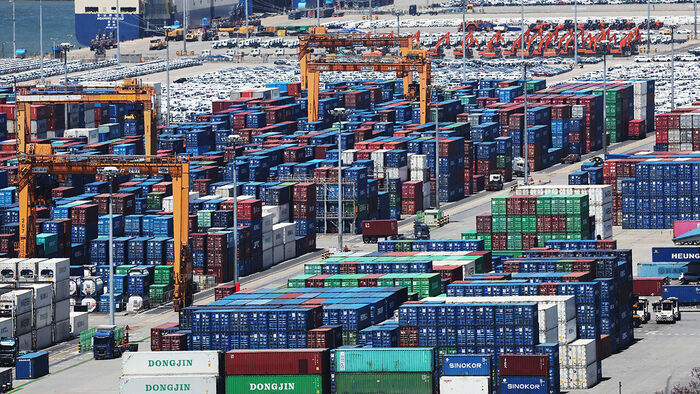
▲ Containers are stacked at Pyeongtaek Port in Gyeonggi Province.
The South Korean economy saw significant growth in the first quarter of this year, driven by a surge in semiconductor exports and a sharp increase in facility investment.
The Bank of Korea announced today (June 9) that the real gross domestic product (GDP) growth rate for the first quarter (compared to the previous quarter, preliminary) was recorded at 1.8%.
This figure is 0.1 percentage points (p) higher than the preliminary estimate released on April 23, which had already significantly exceeded expectations.
Quarterly growth had improved from a contraction of 0.2% in the first quarter of last year to 0.6% in the second and 1.4% in the third, before falling back to -0.1% in the fourth quarter, followed by a sharp rebound at the start of this year.
The growth in exports and facility investment was particularly notable.
In the first quarter, exports increased by 5.9%, led by information technology (IT) items such as semiconductors, while imports also rose by 3.9%, centered on machinery, equipment, and automobiles.
Construction investment grew by 1.4% as both building and civil engineering construction increased, while facility investment rose by 6.6% due to increases in machinery and transportation equipment.
Private consumption grew by 0.6% as spending on goods, such as clothing, and services, such as finance, both increased. Conversely, government consumption fell by 0.4% due to a decrease in health insurance benefit expenditures.
Compared to the preliminary figures, growth rates for facility investment (+1.8%p) and exports (+0.8%p) were revised upward, though imports—a deduction item—also increased by 0.9%p.
Looking at the contribution to growth by sector in the first quarter, net exports (exports minus imports) boosted the growth rate by 1.1%p.
This was because the increase in exports outweighed the rise in imports.
Domestic demand, including private consumption (+0.3%p), construction investment (+0.2%p), and facility investment (+0.6%p), contributed 0.7%p.
By industry, the manufacturing sector grew by 3.9%, led by computers, electronic and optical products, and primary metals.
While the information and communications technology (ICT) manufacturing sector grew by 15.4%, the non-ICT manufacturing sector decreased by 0.9%, showing a contrast.
The electricity, gas, and water supply industries grew by 3.1%, mainly due to water and waste recycling, while the construction industry increased by 2.2% and the agriculture, forestry, and fishing sector by 4.3%.
The service sector grew slightly by 0.6%, as increases in wholesale and retail trade and accommodation and food services were partially offset by a decline in the transportation industry.
Nominal gross national income (GNI) for the first quarter surged by 11.0% from the previous quarter.
Nominal net factor income from the rest of the world increased from 9.2 trillion won to 13.7 trillion won, surpassing the nominal GDP growth rate (10.5%).
Real GNI also increased by 9.2%.
As trade conditions improved and real net factor income from the rest of the world rose from 8.2 trillion won to 11.6 trillion won, the growth rate significantly exceeded real GDP (1.8%).
According to the 2025 national accounts (provisional) results released today, the per capita GNI for 2025 was $36,963, an increase of 0.3% from the previous year.
In Korean won, this amounted to 52.57 million won, a growth rate of 4.6%.
While this is slightly higher than the per capita GNI ($36,855) announced on March 10 during the release of the "2025 Q4 and Annual National Income (Provisional)," the growth rate remained the same at 0.3%.
(Photo: Yonhap News)
※ Please note: This article was translated by AI and may contain errors.