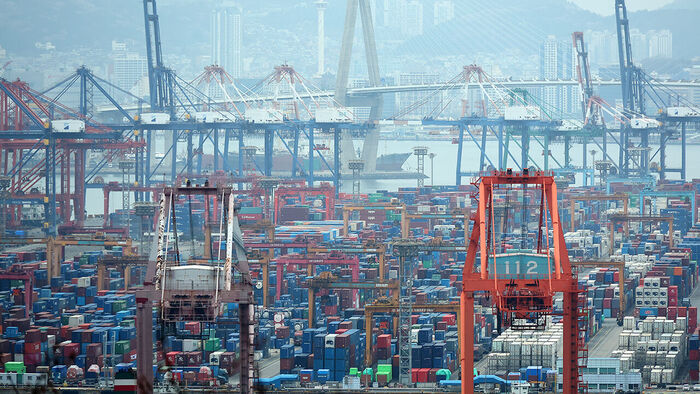
▲ Sinseondae Container Terminal at the Port of Busan packed with containers
South Korea's economy grew significantly in the first quarter of this year, driven by robust semiconductor exports and a surge in facility investment.
The Bank of Korea (BOK) announced on Tuesday (June 9) that the country's real gross domestic product (GDP) growth rate (preliminary estimate, quarter-on-quarter) was compiled at 1.8%.
The figure is 0.1 percentage point higher than the advance estimate released on April 23, which had already significantly exceeded market expectations.
This marks the highest growth rate in five years and six months, since the third quarter of 2020 (2.3%).
Quarterly growth had improved from a contraction of -0.2% in the first quarter of last year to 0.6% in the second quarter and 1.4% in the third quarter, before shrinking again by -0.1% in the fourth quarter. It has rebounded sharply since the start of this year.
Kim Hwa-yong, head of the National Accounts Division at the BOK, said, "The 0.1 percentage point upward revision in the first-quarter real GDP growth has the effect of raising the annual growth rate by 0.1 percentage point. We expect to adjust our forecast based on changed conditions during our economic outlook in August."
At the time of the May economic outlook, the BOK projected this year's real GDP growth at 2.6%.
This means the growth forecast for this year is highly likely to rise to 2.7% or higher.
In the first quarter of this year, growth in exports and facility investment was particularly prominent.
Exports increased by 5.9%, led by information technology (IT) products such as semiconductors, while imports rose by 3.9%, centered on machinery, equipment, and automobiles.
The export growth rate was the highest in five years and six months since the third quarter of 2020 (14.9%), and the import growth rate was the highest in four years and three months since the fourth quarter of 2021 (4.0%).
Construction investment grew 1.4% as both building construction and civil engineering increased, while facility investment rose 6.6% due to an increase in machinery and transport equipment.
The growth rate of facility investment was the highest in five years since the first quarter of 2021 (9.2%).
Private consumption rose 0.6% as spending on goods like clothing and services like finance both increased, whereas government consumption fell 0.4% due to a decrease in health insurance benefit expenditures.
Compared to the advance estimate, growth rates for facility investment (+1.8 percentage points) and exports (+0.8 percentage points) were revised upward, though imports (+0.9 percentage points), which are subtracted from GDP, also rose.
Looking at the contribution of each sector to the first-quarter growth, net exports (exports minus imports) pulled up the growth rate by 1.1 percentage points.
Although imports increased, the growth in exports was much larger.
Domestic demand, including private consumption (+0.3 percentage points), construction investment (+0.2 percentage points), and facility investment (+0.6 percentage points), contributed 0.7 percentage points.
By industry, manufacturing grew 3.9%, driven by computers, electronic and optical devices, and basic metals.
Information and communications technology (ICT) manufacturing surged 15.4%, in sharp contrast to non-ICT manufacturing, which declined 0.9%.
Electricity, gas, and water supply increased by 3.1%, mainly led by water supply and waste recycling, while construction grew 2.2% and agriculture, forestry, and fisheries rose 4.3%.
The services sector (0.6%) saw modest growth as wholesale, retail, accommodation, and food services increased, while transportation and other sectors declined.
Nominal GDP growth in the first quarter reached 10.5%, marking the highest rate in 50 years since the first quarter of 1976 (13.0%).
Regarding this, Director Kim emphasized, "The rise in nominal GDP growth in the first quarter was not due to domestic inflation, but thanks to a significant improvement in the profitability of exporting companies."
He said, "The expansion of corporate operating profits can be used as resources needed to enhance potential growth through structural reforms, such as fostering future industries, as well as fiscal stability through increased corporate taxes. It can also have a positive impact on boosting domestic demand through research and development and expanding facility investment."
He added, "International organizations like the Bank for International Settlements (BIS) measure household and government debt as a ratio to nominal GDP for international comparison. With the expansion of nominal GDP growth, the likelihood of this ratio dropping significantly has increased."
Nominal gross national income (GNI) in the first quarter also jumped 11.0% from the previous quarter.
This was also the highest in 50 years.
Nominal net factor income from abroad increased from 9.2 trillion won to 13.7 trillion won, outperforming the nominal GDP growth rate (10.5%).
The real GNI growth rate (9.2%) was at a record-high level.
As terms of trade improved and real net factor income from abroad increased from 8.2 trillion won to 11.6 trillion won, the growth rate significantly exceeded that of real GDP (1.8%).
The gross saving rate in the first quarter stood at 41.7%, up 5.7 percentage points from the previous quarter.
This is the highest in 37 years and three months since the fourth quarter of 1988 (41.9%), as the growth rate of gross national disposable income (11.2%) was significantly higher than that of final consumption expenditure (1.2 percentage points).
In addition, according to the preliminary national accounts for 2025 released on Tuesday, the per capita GNI for 2025 was $36,963, up 0.3% from the previous year.
In Korean won, it was 52.57 million won, representing a growth rate of 4.6%.
This is slightly higher than the per capita GNI ($36,855) announced on March 10 when the preliminary national income for the fourth quarter and the full year of 2025 was disclosed, though the growth rate remained the same at 0.3%.
Director Kim said, "If the current high nominal growth trend continues, per capita GNI will approach $40,000 within this year. While it is clear that the likelihood of achieving $40,000 earlier than 2028 has increased, it will depend on corporate performance and the direction of the won-dollar exchange rate."
In addition, the GDP growth rate for 2024 was revised from 2.0% to 2.2%, and the GDP growth rate for 2025 was revised from 1.0% to 1.1%.
(Photo: Yonhap News)
※ Please note: This article was translated by AI and may contain errors.