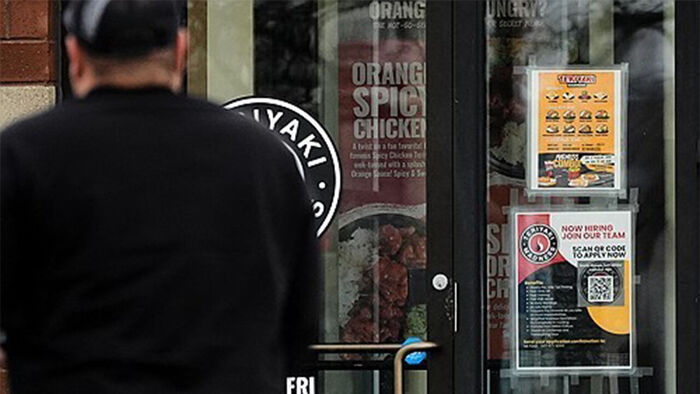
▲ A help wanted sign at a restaurant in Illinois, US
Although the May nonfarm payrolls data recently released by the US Department of Labor showed that the labor market was stronger than expected, a series of surveys suggest that the future outlook is not so bright.
The Conference Board, a US economic research organization, announced on June 8 (local time) that its Employment Trends Index (ETI) for May fell slightly to 107.01 from 107.88 in April.
"While May's payroll employment was strong, rising by 172,000 in the month, the ETI, a forward-looking measure for payrolls, ticked down slightly in May with five of eight components contributing negatively to the index, highlighting potential downside risks to the labor market," said Jannik Schulz, Economic Research Associate at The Conference Board.
He added, "Nonetheless, the ETI is up 2.1 points compared to six months ago, indicating continued resilience in the labor market."
The Conference Board stated that the decline in the index was primarily driven by the share of small firms reporting that jobs are "not able to be filled right now," which dropped to its lowest level since May 2020.
It also analyzed that while job openings increased sharply to above 7.6 million in April, this jump was driven by an idiosyncratic movement in the professional and business services sector, which is not expected to continue.
Generally, when the ETI increases, employment is likely to grow as well, and turning points in the index suggest that a change in the number of jobs is likely to occur in the near future.
Meanwhile, a survey by the Federal Reserve Bank of New York also showed that market expectations have turned somewhat pessimistic.
According to the New York Fed's May Survey of Consumer Expectations, the mean perceived probability of finding a new job within the next 12 months fell by 2.3 percentage points from the previous month to 43.7%.
This is the lowest level since December last year.
On the other hand, the mean perceived probability of losing one's job in the next 12 months rose by 0.5 percentage points from the previous month to 15.1%.
The expected rate of leaving one's job voluntarily over the next 12 months rose to its highest level since February 2023.
This increase was broad-based across age, education, and income levels.
Meanwhile, median one-year-ahead inflation expectations were projected at 3.5%.
This is a slight decrease from 3.6% in April.
Consumer sentiment fell significantly.
The share of households reporting that their current financial situation was worse than a year ago reached its highest level since January 2023.
The proportion of respondents expecting their financial situation to deteriorate over the next year also increased compared to the previous survey.
Bloomberg analyzed that this appears to be influenced by gasoline prices, which rose by the largest margin in years, and aggressive tariff policies.
The perceived probability of missing a minimum debt payment over the next three months also increased.
Earlier, the US Bureau of Labor Statistics reported that total nonfarm payroll employment in May rose by 172,000 from the previous month.
This figure significantly exceeded experts' expectations of an 80,000 increase.
The market interpreted the May employment data as easing concerns about the vulnerability of the US labor market, while heightening anxiety over inflation.
The US Federal Reserve will hold its first Federal Open Market Committee (FOMC) meeting on June 16–17 since the inauguration of its new chair, Kevin Warsh.
The Fed is expected to hold the benchmark interest rate steady at this meeting.
(Photo: AP, Yonhap News)
※ Please note: This article was translated by AI and may contain errors.