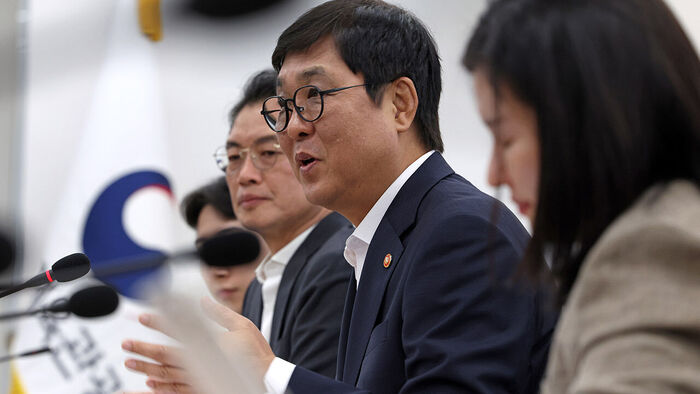
▲ Minister of Culture, Sports and Tourism Choi Hwi-young speaks at the third meeting of the theater subcommittee of the Culture and Arts Policy Advisory Committee, held at the National Museum of Modern and Contemporary Art (MMCA) in Jongno-gu, Seoul, on Tuesday.
Minister of Culture, Sports and Tourism Choi Hwi-young has announced plans to secure a budget to foster representative performances by private theater companies.
Minister Choi made the remarks on Tuesday afternoon during a meeting of the theater subcommittee of the Culture and Arts Policy Advisory Committee at the National Museum of Modern and Contemporary Art (MMCA) in Seoul, where he discussed current issues with theater industry figures.
Tuesday's meeting was attended by actors Lee Ki-young and Kim Su-ro, Lim Dae-il, president of the Korea Theater Actors Association, Bang Ji-young, president of ASSITEJ Korea (International Association of Theatre for Children and Young People Korea), Park Jeong-mi, CEO of Park Company, Kim Do-il, guest professor at Dongguk University's Graduate School of Culture and Arts, and Park Beom-soo, executive director of the Culture Powerhouse Network.
Minister Choi said, "We plan to intensively reflect support projects in next year's budget to help private theater companies continue to develop and perform their representative 'signature' works."
He added that while there were many cases in the past where works created in regional areas became famous after moving to Seoul, such instances are rare nowadays, saying, "We will focus our support on creating new signature works centered on small theaters."
The initiative aims to improve the quality of performances by fostering representative works of each theater company and to restore the size of theater audiences to previous levels.
Minister Choi also stated that the ministry would strengthen support for venue rental fees so that private theater companies can focus on producing their works.
Pointing out that venue rental fees account for the largest portion of expenses in theater, Minister Choi said, "We are conducting various studies to resolve this, but we plan to expedite the rental fee support project first."
Theater industry figures attending the meeting actively welcomed Minister Choi's plan.
Actor Lee Ki-young suggested, "To produce signature works, we need plays by good writers. It would be of great help if we could enable rising writers to leave behind works, even through competitions."
President Bang Ji-young also said, "Support for fostering signature works will benefit theater companies with established, long-running repertoires. This will serve as an opportunity for these groups, which form the backbone of the theater community, to become more active."
During the meeting, general issues facing the culture and arts sector were also discussed.
President Lim Dae-il requested, "I hope the Ministry of Culture, Sports and Tourism, rather than the private sector, will conduct a comprehensive survey of the culture and arts-related pledges made by candidates in the recent local elections."
In response, Minister Choi replied, "We started the survey after the elections because conducting it before could lead to misunderstandings. We are compiling all of them, as the pledges of both the winners and the defeated candidates contain ideas that are necessary for the ministry."
Minister Choi also revealed that the ministry is considering ways to expand the "School Arts Instructor System" currently run by the Korea Arts and Culture Education Service (KACES).
"We are continuously deliberating within the ministry whether to keep the system school-centered as it is now, or to expand it to be community-centered," Minister Choi said. "As it is a good system that allows youth to experience art, we will refine and establish it well."
Regarding the plan to transition the membership system of the National Academy of Arts, Republic of Korea—which is currently operated on a lifetime basis—to a term-limited system, he explained, "The pool of artists whom our society should respect and treat with honor continues to expand and deepen. We have included improving the closed structure of the National Academy of Arts as one of the government's 'normalization of abnormality' tasks."
They also explored ways to support the ASSITEJ World Congress and the International Performing Arts Festival, which will be held in the Suwon area of Gyeonggi Province in July next year.
Minister Choi said, "We will actively reflect the voices from the field so that our country's unique theater works can continue to be performed, and theater can become a performing arts sector that drives K-culture in the future."
(Photo courtesy of the Ministry of Culture, Sports and Tourism, Yonhap News)
※ Please note: This article was translated by AI and may contain errors.