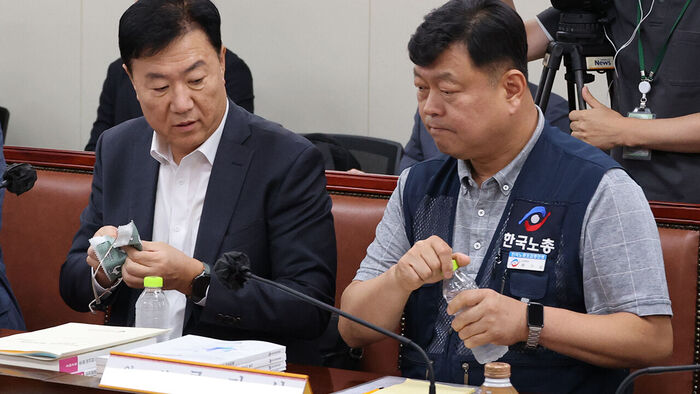
▲ Ryu Ki-jung, executive director of the Korea Enterprises Federation (KEF) and an employer commissioner, and Ryu Ki-seob, secretary-general of the Federation of Korean Trade Unions (FKTU) and a labor commissioner, speak during the fourth plenary session of the Minimum Wage Commission held at the Government Complex Sejong on Tuesday (June 9).
A heated debate took place between labor and management during the fourth plenary session of the Minimum Wage Commission on Tuesday (June 9) to set the minimum wage for 2027, focusing on whether to apply the minimum wage to piece-rate workers such as delivery riders and door-to-door study tutors.
Piece-rate workers are those who are paid based on their performance or the volume of work under a contract, with workers in non-traditional forms of employment (special employment) and platform workers being representative examples.
Following strong demands from the labor sector, the issue was discussed as the first agenda item in this year's Minimum Wage Commission.
The management side argued that piece-rate workers are classified as 'independent contractors' and are not even subject to discussion by the Minimum Wage Commission.
Ryu Ki-jung, executive director of the Korea Enterprises Federation (KEF), argued, "Except for a very small minority whose employee status has been recognized by the courts, workers in special employment are independent contractors, similar to the self-employed." He added, "Setting a minimum wage for individuals whose status as employees has not been confirmed is neither the authority nor the role of the Minimum Wage Commission."
Ryu strongly criticized the demand, saying, "The demand to apply the minimum wage to those who are not recognized as employees is an attempt to freely enjoy the autonomy and choices of an independent contractor while also receiving the status of an employee. It is an argument to selectively enjoy only the advantageous parts."
The management side also argued that the New York system, which the Korean Confederation of Trade Unions (KCTU) cited as an example of a minimum wage for delivery workers during the third plenary session, was not an appropriate comparison.
On the other hand, the labor side countered that introducing a minimum wage for piece-rate workers is a way to reduce unpaid labor, prevent excessive operations, and ensure the safety of workers.
Ryu Ki-seob, secretary-general of the Federation of Korean Trade Unions (FKTU), argued, "Looking at overseas cases and the progress of the safe trucking freight rate system in the domestic trucking industry, when a minimum wage and fair rates were guaranteed, workers' skills improved and safety was strengthened." He added, "Labor productivity improved, with turnover rates and accidents decreasing."
Ryu emphasized, "The Ministry of Employment and Labor's survey, various statistics, overseas cases, and the special provisions for piece-rate and similar forms of work specified in the Minimum Wage Act provide sufficient grounds to support the application of the minimum wage to piece-rate workers."
Lee Mi-seon, vice president of the KCTU, who introduced herself as staging a sit-in protest in front of the Ministry of Employment and Labor in Sejong, said, "Many workers in special employment have testified that they suffer from unpaid labor for which they receive no compensation at all, such as waiting times, travel times, and wasted trips caused by customer cancellations."
The tug-of-war between management and labor continued even during the closed-door meeting.
During the meeting, Yoo Jeong-yeop, policy director of the FKTU, presented a plan to apply the minimum wage to piece-rate workers based on the results of the 'Survey for Discussions on the Separate Application of Minimum Wage to Piece-Rate Workers,' which was conducted as a research project commissioned by the Ministry of Employment and Labor.
In response, the management side pointed out that the survey was conducted by the Korea Labour & Society Institute (KLSI) and claimed that the data was compiled with a bias toward the labor sector.
On the other hand, the labor sector argued that the Korea Labour & Society Institute was legitimately selected through a competitive bidding process by the Ministry of Labor and that there was no issue with its objectivity, demanding that the report be disclosed to the public.
Participants reported that because the gap between the two sides could not be narrowed even on the fundamental premise of whether workers in special employment and platform workers qualify as employees under the Minimum Wage Act, the discussion failed to progress to actual implementation criteria.
The Minimum Wage Commission decided to continue discussions on the piece-rate system at its fifth plenary session on Thursday (June 11).
In next week's meetings, the commission is scheduled to deliberate on the industry-specific minimum wage differentiation, a measure that the management side has been demanding to discuss.
The initial minimum wage proposals from both labor and management are expected to be released as early as next week.
The labor sector is demanding a significant increase, while the business community is calling for a freeze.
This year's minimum wage is set at 10,320 won per hour, up 2.9 percent (290 won) from the previous year.
(Photo: Yonhap News)
※ Please note: This article was translated by AI and may contain errors.