[Anchor]
The South Korean government has announced plans to localize the core infrastructure for physical AI. The goal is to secure original, core technologies to compete against China, which is rapidly mass-producing humanoid robots with massive capital and government support, and Nvidia, which dominates the AI models that serve as the "brains" of these robots.
Reporter Choi Seung-hoon has the story.
[Reporter]
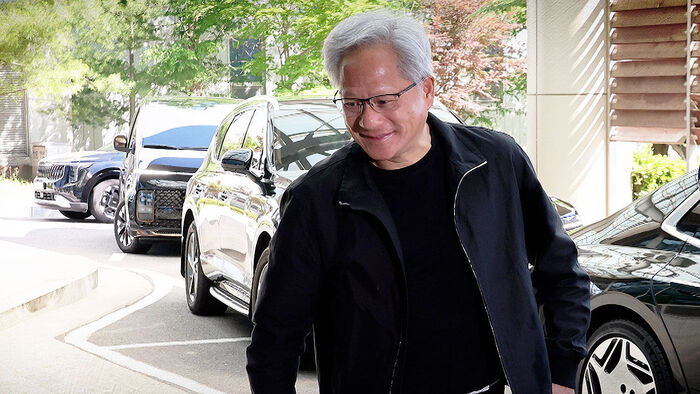
As Nvidia CEO Jensen Huang departed after his five-day visit to South Korea, we asked what both Korea and Nvidia had gained from the trip.
[Jensen Huang / CEO of Nvidia: The biggest contribution Nvidia has made to Korea is inventing the AI industry and building the AI ecosystem.]
The problem is that as cooperation deepens, so does the reliance on Nvidia.
There are two core technologies for "physical AI"—AI that operates in the real world, such as robots and autonomous vehicles.
One is the "world model," a virtual environment where robots can train without the risk of accidents, and the other is the "robot foundation model," which allows them to make decisions and act on their own.
Nvidia is expanding its proprietary ecosystem into these areas to dominate the market. There is concern that if Korean companies rely on Nvidia for these essential technologies, they could lose core profits and technological sovereignty, even while collaborating.
[Jang Young-jae / Distinguished Professor at KAIST: The background of Nvidia's growth lies in that ecosystem strategy. In the physical AI sector, they are also trying to build their own ecosystem and, ultimately, lock users in.]
This is why the government has embarked on the independent development of leading physical AI technologies.
[Ryu Je-myung / 2nd Vice Minister of Science and ICT: It is extremely important to independently secure world model technology that allows robots to learn the laws of physics in a virtual world for application in reality.]
Ten industry, academic, and research institutions, including LG Electronics, Seoul National University, and KAIST, will participate in the project. They plan to invest 34 billion won over two years to develop a domestic world model and a robot foundation model.
Through these models, they aim to increase the success rate of actual robot operations by more than 20 percentage points, a target that exceeds the current global top-tier level.
The plan is to fully leverage Korea's strengths as a manufacturing powerhouse by conducting sufficient testing in manufacturing and logistics settings to accelerate commercialization.
(Reported by Seol Chi-hwan | Video edited by Kim Ho-jin | Graphics by Seok Jin-seon)
※ Please note: This article was translated by AI and may contain errors.
Jensen Huang Departs After 'AI Alliance' Talks... "Securing Core Technology Is Crucial"
Jun 9, 2026