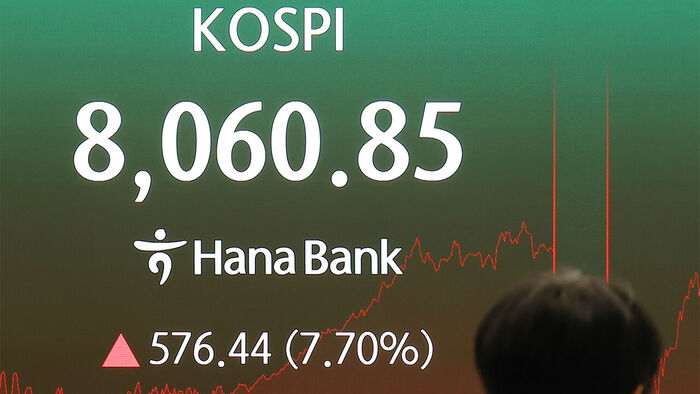
▲ The KOSPI is displayed on a monitor in the dealing room of Hana Bank's headquarters in Jung-gu, Seoul, on Tuesday (June 9), when the index recovered the 8,000 level during intraday trading.
Despite the KOSPI rally, South Korea's price-to-book ratio (PBR) remains lower than those of India and Taiwan. Experts point out that for the domestic stock market to take another leap forward, companies themselves must boost their total shareholder return (TSR) by improving capital efficiency and other measures.
The Boston Consulting Group (BCG) emphasized this in a report published on Wednesday (June 10) titled 'From Discount to Premium: Suggestions for Value Enhancement of Korean Low-PBR Companies.'
BCG analyzed that the KOSPI tripled in just a year and a half, rising from 2,400 at the end of 2024 to 4,200 at the end of 2025, and surpassing the 8,000-point mark in May 2026. The group attributed this to "the government's capital market revitalization policies and the expansion of profits and multiples in four major sectors: semiconductors, defense, shipbuilding, and nuclear power."
However, the report pointed out that it is still too early to declare an end to the "Korea Discount."
The KOSPI's PBR stood at 1.4x at the end of 2025 and is estimated at 1.9x for the end of 2026. This is still low compared to 4.9x for the United States, 4.0x for Taiwan, and even 2.8x for India.
Furthermore, the report noted that excluding the four major sectors, the expected PBR for this year is only 1.0x.
The number of KOSPI-listed companies with a PBR of less than 1x decreased slightly from 553 in 2024 to 541 at the end of 2025, but the report pointed out that 64% of listed companies are still trading below their book value.
BCG emphasized, "If the government's institutional shift and profit improvements in the four major sectors drove the first re-rating, it is now time for the remaining companies to take concrete action to improve capital efficiency and shareholder value to drive the second re-rating."
It added that companies must actively manage their TSR.
This is because growing interest in the stock market due to an increase in retail investors, combined with the rise of shareholder activism, means that failing to manage TSR could lead to direct threats to management control beyond mere stock price underperformance.
BCG cited Japan as a success story, explaining that capital efficiency—specifically, how much profit is generated with less capital—is the key variable in boosting TSR.
Over the past decade, the average annual net profit growth rate of South Korean companies was not low at 4.9%, but their return on equity (ROE) improved by only 0.4 percentage points, from 7.3% to 7.7%.
In contrast, Japan's net profit growth rate during the same period was 4.7%, but its ROE improved by 2.1 percentage points, from 8.7% to 10.8%.
According to BCG, this was "the result of transitioning to a structure that generates the same profit with less capital through the divestment of non-core businesses, share buybacks and cancellations, and increased dividends." Consequently, the Nikkei 225 index surged more than fourfold, from 15,000 at the end of 2013 to 62,000 in May 2026.
To improve TSR, BCG advised South Korean companies to first identify the causes of their undervaluation and then establish strategies such as divesting low-profitability or non-strategic businesses, actively utilizing idle cash and non-core assets, and implementing consistent and visible shareholder returns.
BCG told companies, "The next chapter of the South Korean capital market will be written by companies that reset their strategic focus to maximizing corporate value, align capital allocation, shareholder returns, and market communication in that direction, and restructure their organizations and incentive systems accordingly."
BCG also urged the government, adding, "Just as the Japanese government patiently upgraded its systems over a decade to create a culture where companies place shareholder value at the core of management, the South Korean government must move away from a structure dependent on a few sectors like semiconductors, shipbuilding, and defense, and continue to drive all listed companies across the market to improve their capital efficiency."
(Photo: Yonhap News)
※ Please note: This article was translated by AI and may contain errors.