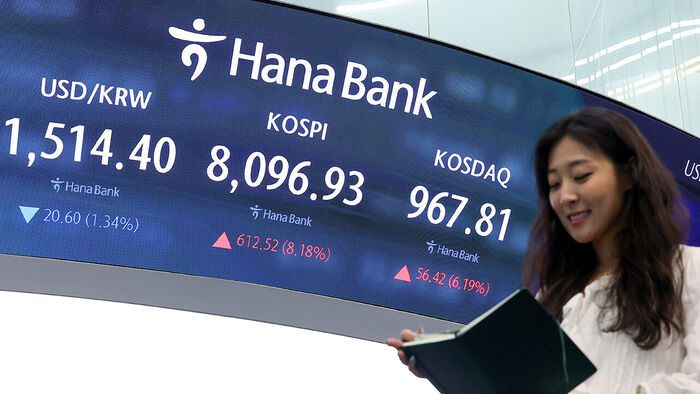
▲ The won-dollar exchange rate, KOSPI, and KOSDAQ indices are displayed on the electronic board at the dealing room of Hana Bank's headquarters in Jung-gu, Seoul, on June 9. On this day, the KOSPI closed at 8,096.93, up 612.52 points (8.18%) from the previous session, while the KOSDAQ closed at 967.81, up 56.42 points (6.19%).
An analysis shows that the percentage of days when exchange-traded fund (ETF) prices rose on the days retail investors net purchased them in the domestic stock market has increased significantly.
This indicates that the influence of retail investors has grown significantly in the domestic ETF market, which hovers around 500 trillion won.
According to a report published by KB Securities titled "Where Do Retail Purchases Actually Work in ETFs?", the "co-movement ratio"—the rate at which retail investors' net ETF purchases and returns move in the same direction—stood at 47.5% this year.
This is the result of analyzing whether the direction of retail net purchases and ETF returns aligned over the past six years for 615 domestically listed ETFs with domestic underlying assets.
The co-movement ratio rose from 38% in 2021 to 39.6% in 2022, and surpassed 40% in 2023 to reach 41.7%.
It continued to climb to 41.9% in 2024, 45.1% in 2025, and 47.5% this year.
In 2021, the co-movement ratio for retail investors differed by more than 10 percentage points from that of foreign investors, who recorded 51.6%. However, this year, it neared a similar level to foreigners, who stood at 47.7%.
KB Securities analyzed that this means the influence of retail investors in the ETF market has become almost equal to that of foreign investors.
Researcher Park Yu-an said, "As the scale of retail capital has grown, its impact on the stock market has also increased. With better access to information than in the past, retail investors' trading patterns have become similar to those of foreign investors."
This phenomenon, where ETF prices rose on days when retail investors bought, was relatively more pronounced in small and mid-sized ETFs (100 billion to 1 trillion won).
This year, the co-movement ratio between retail supply-demand and returns was found to be 47.9% for ETFs with net assets of 100 billion to 500 billion won, and 47.7% for ETFs with net assets of 500 billion to 1 trillion won.
ETFs with net assets of less than 100 billion won also recorded 47.5%.
On the other hand, the co-movement ratio for ETFs with net assets of 1 trillion won or more was 40.2%, the lowest among all categories.
In particular, the co-movement ratio was concentrated in specific themes such as semiconductors, shareholder value, and "Value-up" initiatives among small and mid-sized ETFs.
In the case of the TIMEFOLIO TIME Korea Value-Up Active ETF, the ratio stood at 65.7%, while the SOL Semiconductor Front-End Process ETF recorded 61.8%, and the ACE Life Asset Shareholder Value Active ETF recorded 59.4% this year.
A ratio exceeding 50% means that there were more instances where the ETF price rose on the days retail investors engaged in buying.
In addition to the co-movement ratio, the performance at the time of purchase was also favorable.
The SOL Semiconductor Front-End Process ETF recorded an average daily return of 1.25% for retail net purchases based on the 2025 to 2026 period, and rose to 3.20% when looking at this year alone.
However, the co-movement ratio between retail supply-demand and returns was low for leverage ETFs.
The co-movement ratio was found to be 12.5% for KODEX Leverage, 13.8% for KODEX Kosdaq 150 Leverage, and 17.2% for TIGER Leverage.
This means that on most days when retail investors bought, the prices of leverage ETFs fell.
This stands in stark contrast to the 55.8% co-movement ratio of foreign investors for KODEX Leverage.
Park explained, "These funds (buying leverage ETFs) seem to have a stronger character of bargain hunting rather than trend following. It is interpreted that the co-movement ratio is low because retail buying often flows in from the early stages of a price decline."
(Photo: Yonhap News)
※ Please note: This article was translated by AI and may contain errors.