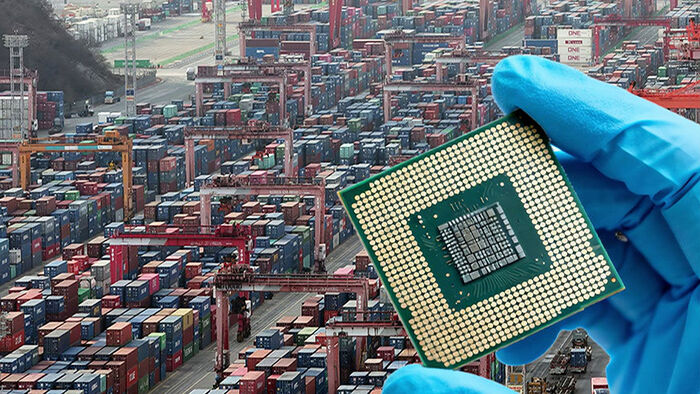
▲ Semiconductors
An analysis suggests that aggressive facility expansions by memory semiconductor manufacturers are driving an unprecedented "supercycle" in the wafer fabrication equipment (WFE) market.
According to U.S. financial news outlet MarketWatch on June 9 (local time), UBS analyst Timothy Arcuri stated in a report that the shortage of cleanroom space—essential for semiconductor manufacturing—is gradually easing as Micron, Samsung Electronics, and SK Hynix begin operations at new fabrication plants (fabs).
He added that various foundry companies are also contributing to the expansion of WFE shipments, which include equipment for lithography, deposition, etching, and cleaning, by securing new cleanroom space or optimizing existing facilities.
Arcuri assessed that the WFE industry could be in the "early stages of a supercycle" that may see revenue reach $250 billion (approximately 380 trillion won) by 2028.
He projected that WFE revenue this year will grow 27% year-over-year to $147 billion (approximately 223 trillion won).
Of this, revenue for DRAM and NAND flash equipment is expected to surge by 50%, while revenue for logic chip manufacturing equipment supplied to companies like TSMC and Intel is projected to increase by 12%.
For next year, he forecast that total WFE revenue will reach $200 billion (approximately 304 trillion won), a 35% increase from this year.
UBS raised its forecast for next year's memory WFE revenue by $10.5 billion (approximately 16 trillion won) from its previous estimate.
The firm explained that this adjustment reflects the fact that most of the new production capacity coming online is concentrated on DRAM, supported by long-term supply contracts.
Regarding NAND, Arcuri expects the proportion of cleanroom space to increase starting in the second half of 2028.
What Arcuri highlighted is the unusual expansion of demand visibility.
He stated that semiconductor manufacturing clients have begun sharing demand visibility for the next eight quarters with equipment suppliers.
"In my nearly 30 years of covering the semiconductor sector, I have never heard of this phenomenon," Arcuri remarked.
While some concerns have been raised that the production capacity of ASML's extreme ultraviolet (EUV) lithography equipment could become a bottleneck for WFE growth, Arcuri disagreed.
He explained that ASML has sufficient production capacity to achieve over $46 billion (approximately 70 trillion won) in system revenue next year, which supports his forecast of $200 billion in WFE revenue for 2027.
Arcuri named Applied Materials (AMAT) and Lam Research as his top picks.
He assessed that KLA faces valuation pressure.
"While fab availability is limited in the short term, semiconductor companies are finding ways to maximize utilization rates," Arcuri said, noting that several large fabs are expected to enter full-scale operation from the second half of this year through 2027.
※ Please note: This article was translated by AI and may contain errors.