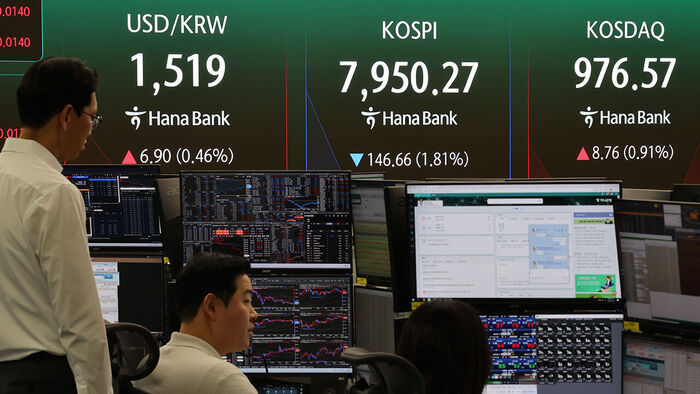
▲ Employees work at the dealing room of the Hana Bank headquarters in Jung-gu, Seoul, on the 10th.
Trading volume on the KOSPI has plummeted as the index shows high volatility, characterized by repeated sharp gains and losses this month.
According to the Korea Exchange on the 10th, the average daily trading volume on the KOSPI from June 1 to 9 was recorded at 511.76 million shares.
This marks the lowest level so far this year.
The average daily trading volume was 550.01 million shares in January, 1.048 billion in February, 1.107 billion in March, 947.18 million in April, and 698.79 million in May.
Compared to the average daily trading volume of 869.20 million shares from January to May, this month's figure represents a 41.12% decrease.
The sharp decline in trading volume is attributed to the "dizzying" market conditions.
As the KOSPI continues to swing wildly day after day, investor sentiment has frozen, leading to a reduction in overall trading activity.
In particular, on the 8th and 9th, the market saw a "V-shaped" fluctuation, falling 8.29% before rising 8.19%, which caused trading volume to drop to the 400 million share range.
Yesterday, the KOSPI 200 Volatility Index, often referred to as the "Korean fear index," soared to 91.23, marking the highest closing level in history.
Securities firms predict high volatility for this month due to profit-taking on leading stocks following the KOSPI's short-term surge and concerns over interest rate hikes in major economies.
Immediate factors include the upcoming release of U.S. consumer and producer price indices this week, as well as the expiration of futures and options in the domestic stock market.
Additionally, SpaceX, which has become a "black hole" for global stock market capital, is set to go public.
Next week, the Bank of Japan's Monetary Policy Meeting and the U.S. Federal Reserve's Federal Open Market Committee (FOMC) meeting are scheduled.
Market analysts suggest that the market is under pressure as investors take Japan's interest rate hike as a given, and believe the Federal Reserve will be unable to lower interest rates as U.S. President Donald Trump desires.
Furthermore, persistent military clashes between the U.S. and Iran in the Strait of Hormuz are adding to the market's volatility.
(Photo: Yonhap News)
※ Please note: This article was translated by AI and may contain errors.