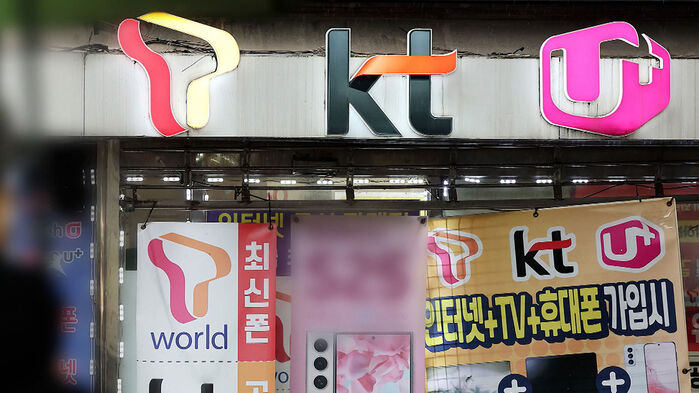
▲ Three Major Telecom Carriers
A "priority transmission service for emergency rescue communications," which ensures that calls made by firefighters are connected first even when communication networks are congested due to large-scale fires or complex disasters, officially begins today (June 10).
The Ministry of Science and ICT announced that the service, promoted by the National Fire Agency and the three major mobile carriers, has launched as of today.
The core of this service is to ensure that communications between firefighters, callers, and emergency medical physicians are transmitted first, even when there is a surge in communication demand at disaster sites.
The three mobile carriers have applied dedicated SIM cards to firefighters' devices that distinguish them from regular subscribers, allowing their signals to be processed with priority during network congestion.
This service began when LG Uplus proposed it to the National Fire Agency as part of its corporate social responsibility initiatives.
Subsequently, SK Telecom and KT joined the project, and the three carriers jointly conducted technical verification before reaching commercialization.
While current network neutrality guidelines generally mandate that internet traffic be treated equally, they allow for priority transmission when classified as a "special service" that meets certain requirements, such as limited use and separate quality management.
According to the Ministry of Science and ICT, this is the first case to be recognized as meeting the requirements for a special service since the guidelines were established in 2011.
Major countries including the United States, Germany, and Japan have already been operating priority transmission systems for emergency rescue in the public safety sector to guarantee communication quality for rescue workers.
The Ministry of Science and ICT explained that this service is separate from the Public Safety-LTE (PS-LTE) network, which supports communication between disaster safety agencies such as the National Fire Agency, and will instead play a role in supporting calls between firefighters and the general public or medical staff.
The ministry expects that once the three carriers complete the nationwide rollout of their 5G Standalone (SA) networks by the end of this year, it will become much easier to guarantee customized quality for each agency and user, further advancing public safety communication services, including emergency rescue communications.
※ Please note: This article was translated by AI and may contain errors.