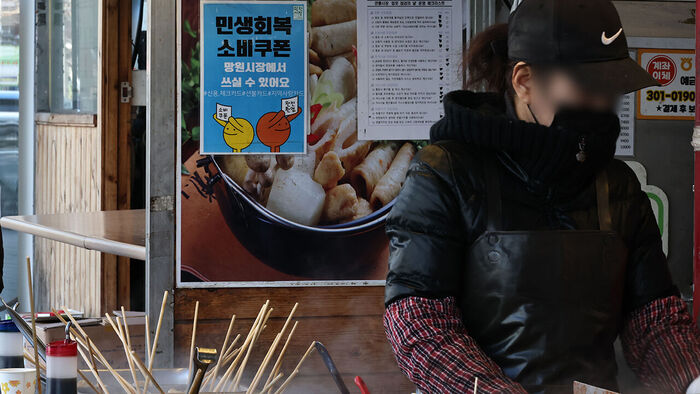
▲ A notice on "livelihood recovery" consumption coupons posted at a shop in Mangwon Market in Mapo-gu, Seoul, on December 1 last year.
A study by the Bank of Korea (BOK) estimates that the "livelihood recovery" consumption coupons distributed by the government last year generated approximately 2.8 trillion won in additional sales nationwide.
In its "BOK Issue Note: Evaluation of the Economic Effects of Livelihood Recovery Consumption Coupons" report released on Wednesday (June 10), the central bank stated, "About 30.9% of the fiscal input led to an increase in additional sales at businesses where the consumption coupons were used."
The BOK analyzed the sales-boosting effects of the coupons by building a big data database of sales from six credit card companies through which the consumption coupons were distributed.
Local currency certificates and prepaid cards were excluded from the analysis.
The analysis showed that the average monthly sales per business accepting the coupons increased by 2.91% more than those at businesses that did not accept them.
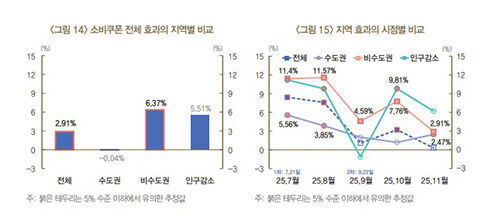
▲ Estimated sales-boosting effects of consumption coupons by region
By region, sales at businesses in non-metropolitan areas and depopulated areas increased by 6.37% and 5.51%, respectively, showing a significantly larger effect than in the Seoul metropolitan area (-0.04%).
Ha Jeong-seok, a manager at the BOK's Research Department, explained, "The amount of consumption coupons distributed was larger in non-metropolitan areas and depopulated rural areas, while in the metropolitan area, sales at non-participating businesses also remained relatively robust, resulting in a smaller difference in sales between participating and non-participating businesses."
By period, the sales-boosting effect was concentrated in July and August, the early stages of the policy implementation.
The effect lasted for about two months after the first distribution, which had a larger payout, and for one month after the second distribution.
By industry, the sales-boosting effect was significant for retail stores selling miscellaneous goods such as clothing, groceries, and optical shops (8.32%), restaurants (5.84%), and the leisure and recreation sector (5.39%).
On the other hand, private academies (-9.25%) and clinics and hospitals (-5.91%) saw a decrease in sales at participating businesses compared to non-participating ones. The BOK analyzed that this appears to be a result of households increasing their spending at relatively larger hospitals and clinics as their disposable income increased.
Taken together, the consumption coupons distributed via credit cards were estimated to have generated a combined total of approximately 2.8 trillion won in additional sales across all participating businesses nationwide.
The BOK added that this amount could range from approximately 1.4 trillion to 3.6 trillion won depending on the estimation method.
Based on the 9.1 trillion won distributed via credit cards out of the total consumption coupon budget, about 30.9% of the fiscal input translated into additional sales at participating businesses.
Separately, a survey conducted to evaluate the coupons' effect on stimulating household consumption estimated the marginal propensity to consume (MPC) for the first and second rounds of coupons at 0.20.
This means that a household receiving 100,000 won in consumption coupons increased new consumption by an average of 20,000 won.
This is slightly lower than the estimated MPC of 0.19 to 0.42 for the COVID-19 consumption support funds.
The BOK explained that this was likely influenced by the fact that the contraction in consumption immediately before the distribution of the coupons was less severe than during the pandemic.
By income level, the MPC for the first quintile (the bottom 20%) was 0.25, which was higher than that of the fifth quintile (0.17).
The survey was conducted twice among adults nationwide who received the coupons: the first round from August 13 to 20, 2025 (1,536 respondents), and the second round from October 27 to November 7, 2025 (1,010 respondents).
Considering both the sales-boosting effect at businesses and the stimulation of household consumption, the BOK estimated that last year's livelihood recovery consumption coupons boosted annual gross domestic product (GDP) growth by approximately 0.12%.
Ha said, "The policy pathway of boosting economic growth by turning increased household disposable income from the coupons into actual consumption and higher sales at participating businesses worked effectively." He added, "When implementing similar policies in the future, precisely designing the timing, differential support methods, and eligible businesses could maximize the economic effects."
(Photo: Provided by the Bank of Korea, Yonhap News)
※ Please note: This article was translated by AI and may contain errors.