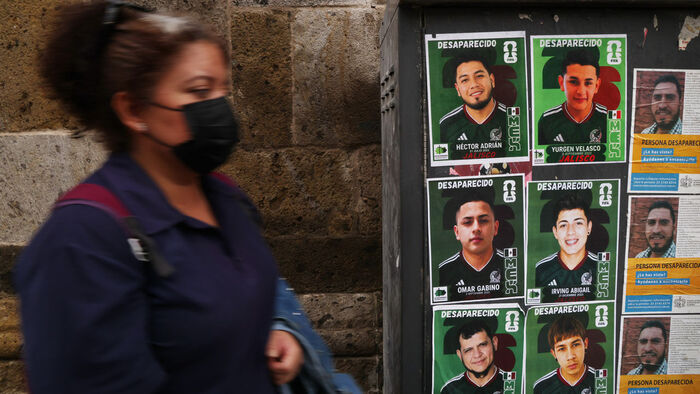
▲ A missing persons flyer designed to look like a World Cup poster is posted in downtown Guadalajara, Mexico, on the afternoon of June 9 (local time), ahead of the 2026 World Cup.
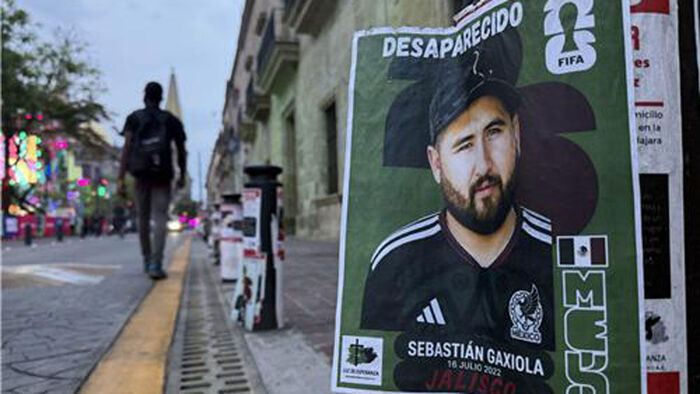
At first glance, it looks like a profile poster of a Mexican national football team player, but the closer you look, the more unusual details emerge.
At the top of the poster, where the player's name should be, the word "missing" is written in Spanish, and at the bottom, the date and location of the suspected disappearance are listed.
These missing persons flyers were specially created to coincide with the World Cup, aiming to catch the attention of the crowds gathering from all over the world.
Guadalajara, Mexico, is buzzing with excitement for the 2026 World Cup.
Despite concerns over the city's notorious public safety, walking through the downtown area in broad daylight rarely makes one directly feel such danger.
But the countless missing persons flyers plastered across the streets—on lampposts, traffic bollards, and traffic light poles—hint at the bitter reality of this city.
A massive monument towering in the heart of the city is where this reality is felt most painfully.
Originally built in the 1950s to honor military cadets who died in the war with the United States, the "Rotary of the Boy Heroes" is now called the "Rotary of the Disappeared" by locals.
As missing persons cases linked to drug cartels surged, desperate families plastered the entire columns and walls of the monument with flyers of their missing loved ones, eventually changing the very name of the place.
Currently, the number of missing persons across Mexico exceeds 134,000.
In particular, the state of Jalisco, of which Guadalajara is the capital, is considered one of the regions with the highest number of reported disappearances in the country.
Under these circumstances, local residents have taken advantage of the World Cup period, which draws football fans from around the globe, to urge international attention to the issue of missing persons.
The missing persons flyers, designed as national team player profiles with photos edited to show them wearing the Mexican national football team uniform, are part of this effort.
Ahead of the tournament's opening, families of the missing and support groups are focusing on plastering these fake profile flyers around the FIFA Fan Festival venue and major tourist attractions in Guadalajara.
Through this, they are desperately trying to catch the attention of tourists.

Gustavo, a 28-year-old graduate of the University of Guadalajara, lamented, "The issue of missing persons has already reached an extremely serious level," adding, "An acquaintance of mine had their entire family of four vanish without a trace."
He continued, "Once someone goes missing, it is extremely rare for them to return alive, and there are countless families desperately searching for over 10 or 20 years."
He also pointed out, "With the government budget being severely lacking and the missing persons issue being the most urgent matter, there were significant voices of opposition arguing that the World Cup should not be hosted here."
According to reports by the EFE news agency, the Jalisco state prosecutor's office specializing in missing persons was unable to recruit any new personnel this year due to budget shortages.
To make matters worse, the state's victim support commission is also in a dire situation, with only 15 advisors tasked with tracking nearly 16,000 investigation records.
Miguel, a 35-year-old Uber driver who has lived in Guadalajara his entire life, shared, "Mainly young girls and young men are targeted. They just leave to go to school or meet up with friends and never return home."
Miguel added, "One of my friends was kidnapped from his home at the age of 15, endured forced labor by a cartel for a whopping 10 years, and barely managed to escape."
He explained that his friend was able to save his life by showing the resourcefulness of intentionally getting arrested by the police and serving time in prison after his escape.
(Photo: Yonhap News)
※ Please note: This article was translated by AI and may contain errors.