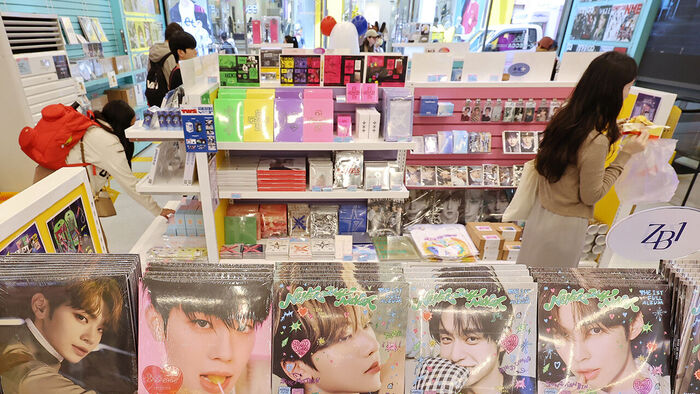
▲ File Photo
Unfair terms and conditions in paid idol fan club memberships, which offer benefits such as concert pre-sales and exclusive merchandise purchases, have been widely uncovered during an investigation by the Fair Trade Commission (FTC).
These clauses include unfairly restricting refunds or evading liability by stating that the agency is not responsible even if a group member leaves.
A total of 24 companies, including 18 entertainment agencies and six fandom platform operators caught in the probe, have agreed to voluntarily correct their unfair terms.
According to the FTC on Wednesday (June 10), an investigation into the paid fan club membership terms of 24 companies revealed eight types of unfair clauses.
Paid memberships generally cost between 10,000 to 50,000 won, and the most prominent unfair terms were refund restrictions.
Big Hit Music specified that refunds are not allowed if more than seven days have passed since joining the membership or if any benefits have been used. Starship Entertainment's terms also stated that while cancellation is possible within seven days from the day after payment, refunds are unavailable if any benefits have been received.
The benefits of paid fan club memberships are linked to the artists' promotional schedules, making them difficult to provide on a regular or quantitative basis, and the benefits naturally vary depending on when a user signs up.
The FTC determined that if users are dissatisfied with the benefits provided after joining, they should be allowed to cancel and receive a partial refund mid-term, and restricting this constitutes an unfairly disadvantageous clause for consumers.
Consequently, the businesses agreed to revise their terms to allow full refunds within seven days of joining if there is no history of use. If seven days have passed or there is a history of use, they will refund the remaining balance after deducting a cancellation fee (typically 10% of the membership fee) and the value of used benefits (calculated based on specific benefits used or elapsed time).
There were also clauses that unfairly exempted the companies from duties and liabilities.
SM Entertainment's terms stated, "Please note that if you cancel your payment after renewing your membership, the remaining validity period of your previous membership will not be restored."
However, the FTC explained that if a consumer cancels a membership renewal, the business is obligated to restore the consumer's status to the remaining validity period they had before the renewal.
YG Entertainment ruled out refunds in cases where "content regarding changed members cannot be provided to membership users due to reasons such as the addition, departure, or replacement of individual members of an artist group, without any fault on the part of YG Entertainment."
Kakao Entertainment stated that it "is not responsible for service disruptions caused by the member's own fault," while CJ ENM wrote in its terms that it is not liable for "damages arising from unauthorized third-party access to or illegal use of its servers."
The FTC ordered corrections, pointing out that "the companies are uniformly exempting themselves from liability regarding service provision and damages, even in cases that could be considered within the scope of the business's management responsibility, such as an artist's departure."
Antenna and Weverse Company also restricted user rights by stating that they "may suspend membership services due to management reasons, etc."
The FTC pointed out that the reasons for service modification or suspension were defined too abstractly, and ordered them to be specified, such as company division or merger, business transfer or abolition, business termination, or the expiration of an artist's exclusive contract.
Blue Garage, which is contracted to manage JYP Entertainment's paid memberships, stipulated that the operator could terminate user contracts based on vague and unclear grounds such as "reasonable judgment," while Knowmerce specified that contracts could be terminated without prior notice.
Following the FTC's findings, the companies agreed to define the grounds for contract cancellation, termination, and service restriction specifically and clearly. They will also provide consumers with an opportunity to explain themselves before any measures are taken, allowing termination or restriction only if the issue is not resolved.
In addition, clauses allowing unilateral deletion of posts and those broadly defining the scope of third-party personal information sharing or retention periods were also flagged as unfair.
Gwak Go-eun, head of the FTC's Terms and Special Transactions Division, said, "As the outer boundaries of the K-pop market expand globally, we proactively inspected the unfair terms of paid fan club membership services." She added, "This will serve as an important milestone in protecting consumer rights within the industry and establishing a fair and transparent trading order that matches the scale of the K-pop fandom."
The businesses plan to correct the refund-related clauses by the end of the year and revise the other clauses as soon as possible.
Consumers who previously could not receive refunds after joining paid fan club memberships will now be able to get refunds after a settlement based on the elapsed period or usage amount, which is expected to enhance consumer convenience.
(Photo: Yonhap News)
※ Please note: This article was translated by AI and may contain errors.