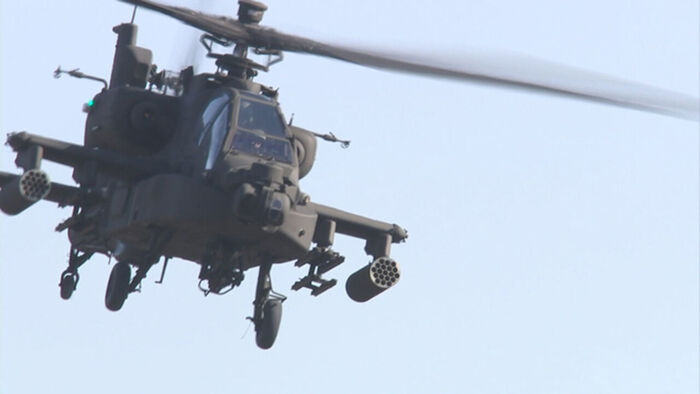
▲ Apache Helicopter
Various speculations are emerging regarding the cause of the U.S. Army helicopter crash that triggered the resumption of attacks between the United States and Iran.
The crashed AH-64 Apache helicopter went down around 3 a.m. on June 9, Oman local time, while patrolling near the Strait of Hormuz and the coast of Oman, and both pilots were rescued about 30 minutes later.
U.S. President Donald Trump claimed that the crash was a shootdown by Iran, while some reports indicated that the helicopter crashed after colliding with an Iranian drone, though it remains unclear whether the collision was intentional.
Cameron Chell, CEO of Draganfly, a drone technology company based in Saskatoon, Canada, told Fox News Digital on June 9 (U.S. Eastern Time) that the likelihood of the Apache being shot down by a drone attack is very low.
He pointed out, "Iran does not have drones that shoot down Apaches. Iran has missiles that shoot down Apaches."
He added, "Iran does not possess surface-to-air drones in the traditional sense, nor are they known to have them unless they have newly developed such a capability."
He added, "Typical surface-to-air drone capabilities are used to shoot down other drones, not necessarily aircraft."
Chell explained, "Iran has drones that strike facilities or target infrastructure, whether it's ships or factories. But they do not target aircraft. General drones designed to shoot down aerial assets are made to shoot down other drones, not larger assets like helicopters."
He analyzed that existing Iranian drones are not fast or sophisticated enough to pursue and bring down a moving helicopter, saying, "An Iranian drone that physically collides with and shoots down a helicopter does not exist in their arsenal at this time."
He said that if the cause of the crash was not a mechanical defect within the Apache helicopter itself, the evidence suggests that a completely different class of weapon, rather than a drone, was used in the attack, stating, "I believe it was some kind of surface-to-air missile, possibly a shoulder-fired missile."
He analyzed, "If the crash occurred due to a hostile act, it was likely some kind of surface-to-air missile, probably portable or shoulder-fired."
Chell also mentioned the possibility that the helicopter's mission conditions could have been a factor behind the incident.
He added, "Apache helicopters are very frequently used in anti-drone operations. So while it is possible it was hit by a drone and was engaging with it, I see that likelihood as very low. Alternatively, it could have been deployed in an anti-drone operation and crashed due to some mechanical issue, independent of being hit."
To date, Iran has not released an official statement or claimed responsibility for the crash.
Chell said, "Normally, if they had shot down an aerial asset like this, they would have made a big deal about claiming it. It could have been carried out by a decentralized unit (acting independently)."
President Trump claimed that the Apache helicopter crash was due to an Iranian attack, foreshadowing retaliatory measures by saying, "The United States must inevitably respond to this attack," and subsequently announced that the U.S. had launched "attacks of a self-defensive nature" against Iran.
The U.S. attacks on Iran began around 12:30 a.m. on June 10, Tehran local time, targeting Iranian military facilities and communication towers.
Subsequently, Iran also fired missiles at U.S. military bases across the Middle East.
(Photo courtesy of Yonhap News TV, Yonhap News)
※ Please note: This article was translated by AI and may contain errors.