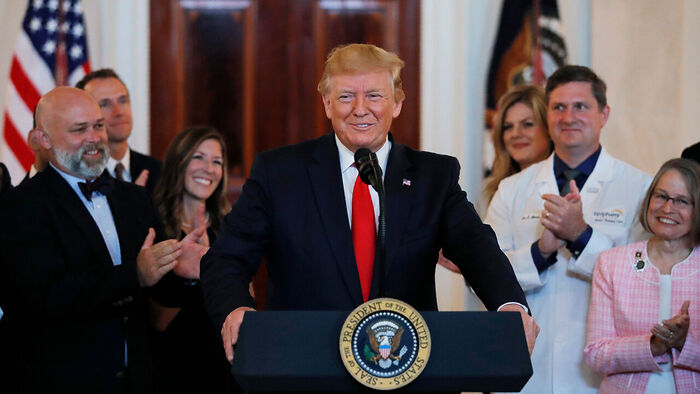
▲ U.S. President Donald Trump
Although the United States conducted airstrikes on Iran in retaliation for the crash of an Apache helicopter, U.S. President Donald Trump maintains that a deal to end hostilities with Iran is still imminent, the U.S. political news outlet Politico reported on June 9 (local time).
According to the report, a senior White House official, speaking on condition of anonymity, stated, "Nothing has changed regarding the progress of the deal," adding that "an agreement with Tehran is still close."
The official explained, "The military sphere and the negotiation sphere are two separate baskets," noting that "because a helicopter was shot down yesterday, we had to take a proportionate response, but at the same time, negotiations for a deal can continue."
Previously, U.S. Central Command stated regarding the airstrikes that they were a "proportionate measure against Iran's acts of aggression."
This is being viewed as an approach that differs in tone from President Trump's past hardline rhetoric, in which he warned that he could "end civilization" in Iran.
U.S. Vice President JD Vance also offered an optimistic outlook in an interview with CBS News, suggesting that negotiations with Iran are nearing a conclusion.
Earlier, the U.S. and Iran engaged in a military exchange, trading retaliatory strikes following the crash of a U.S. Apache helicopter in the Strait of Hormuz.
Even with the resumption of clashes, the White House is framing the situation as a temporary friction in the process of peace negotiations rather than a return to war.
It is reported that President Trump recently told his aides that he would not resume full-scale war with Iran unless U.S. military casualties occur.
The helicopter that crashed was carrying two pilots, both of whom were reported to be safe.
While President Trump claimed the helicopter was shot down by Iran, there are various speculations regarding the exact cause of the crash.
Politico reported that both inside and outside the White House, some are raising questions about the current strategy of relying on diplomacy while the Strait of Hormuz is effectively blockaded by Iran.
One individual close to the White House said, "It is surprising that President Trump has not launched a full-scale additional attack," adding, "It is difficult to be certain why he is not applying enough pressure to bring Iran back to its knees."
The individual mentioned the possibility that U.S. ammunition stockpiles or military capacity issues might be a factor, adding, "It could also be that the president simply does not want to escalate the situation further."
The Israel variable is also complicating the peace negotiations.
Israel has recently exchanged mutual attacks with Iran and continues military operations in Lebanon targeting the pro-Iranian militant group Hezbollah, placing a burden on U.S. mediation efforts.
(Photo: AP, Yonhap News)
※ Please note: This article was translated by AI and may contain errors.