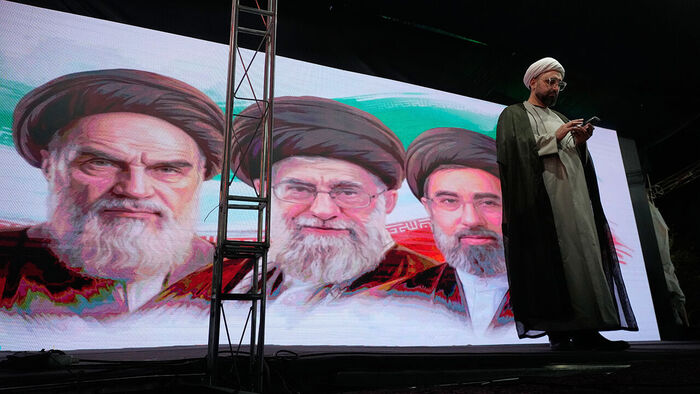
▲ A billboard displaying photos of Iran's past supreme leaders.
Observers suggest that Iran's new leadership has shifted its foreign policy, moving away from the restraint maintained for decades toward a hardline approach.
The recent operation in which Iran directly struck the Israeli mainland to rescue its pro-Iranian proxy forces is cited as a clear example of this change.
Trita Parsi, executive vice president of the Quincy Institute for Responsible Statecraft, a U.S. foreign policy think tank, noted in an interview with CNN on June 9 (local time) that "Iran has demonstrated both the capability and the will to use force even in response to Israeli military actions directed at third countries, not just Iran itself." He added, "This is the first time in decades that this has happened."
Danny Citrinowicz, a former head of the Iran branch of the Israel Defense Forces' Military Intelligence Directorate, also told CNN that "Iran is trying to create a 'new equation' to prevent Israel from acting rashly not only against the Iranian mainland but also against Iran's proxy forces in the region."
He also wrote on X (formerly Twitter) that "the events of the last 24 hours (in which Iran attacked Israel) show that there is a growing perception among Iran's current leadership that 'what cannot be solved through diplomacy can be achieved through force.'"
The analysis suggests that by exceptionally stepping forward to retaliate on behalf of its pro-Iranian proxies, Iran has effectively abandoned the cautious foreign strategy it has long adhered to.
Initially, while maintaining a hostile relationship with the United States, Iran had shown cautious and restrained responses through proxy wars and choreographed attacks.
In January 2020, following the assassination of Qasem Soleimani, commander of the Quds Force of the Islamic Revolutionary Guard Corps (IRGC), ordered by U.S. President Donald Trump, Iran notified the U.S. of its retaliatory strike in advance, and it avoided direct confrontation with U.S. forces during the war with Israel last year.
However, CNN pointed out that Iran's new generation of leadership is strongly demonstrating a will to influence the situation in the Middle East, even at the risk of escalation.
Although President Trump has previously described the new leadership as "rational and quite reasonable" compared to the past, they are in fact showing a more hardline and aggressive tendency than their predecessors.
Iran has warned that it could further raise the level of military tension in the future.
Iran's semi-official Tasnim News Agency quoted an anonymous military source on this day as saying, "If Israel and the U.S. think they can keep Iran and the 'Axis of Resistance' (Iran's proxy forces) within a controllable range through 'managed tension' in the face of their crimes, they are making a foolish mistake."
(Photo: AP, Yonhap News)
※ Please note: This article was translated by AI and may contain errors.