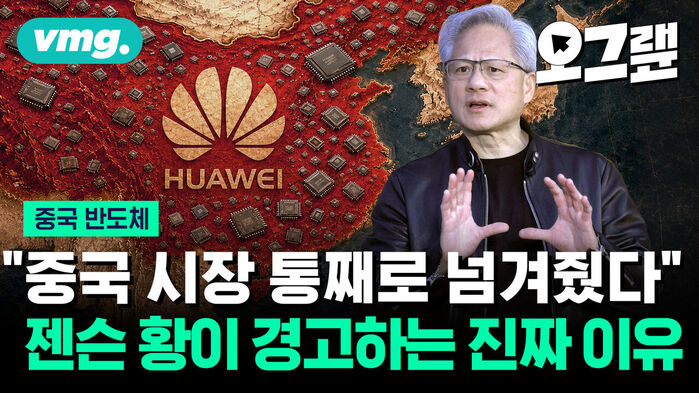
South Korea and Taiwan have emerged as the biggest beneficiaries of the AI semiconductor boom. In Taiwan, TSMC dominates manufacturing and packaging, capturing 38% of the $320 billion global foundry 2.0 market. Meanwhile, South Korea has become the core of the memory supply chain, recording a 79% market share in HBM as of the fourth quarter of 2025. However, in the meantime, China is also strengthening its independent path, led by Huawei and SMIC.
In this week's "Oh! Graph," we have prepared a story on the semiconductor landscape involving South Korea, Taiwan, and China, covering TSMC's CoWoS packaging and 2-nanometer process, South Korea's HBM competitiveness, Huawei's "Tau scaling" and logic folding strategies, and China's 1.5 trillion yuan investment in semiconductors. Through five graphs, we examine whether China's semiconductor industry, which has survived despite U.S. sanctions, can truly threaten South Korea and Taiwan, and where the race for AI semiconductor hegemony is headed.
Reported by An Hyemin | Camera by Hwang Se-hoe and Park Woo-jin | Edited by Lee Ki-eun | Designed by Ahn Jun-seok | Intern: Kim Soo-young | Produced by SBS Knowledge Contents IP Team
※ Please note: This article was translated by AI and may contain errors.
Jensen Huang: "We Have Ceded the Chinese Market to Huawei"... The Semiconductor Tri-War Between South Korea, Taiwan, and China
By An Hyemin | Jun 10, 2026