[Anchor]
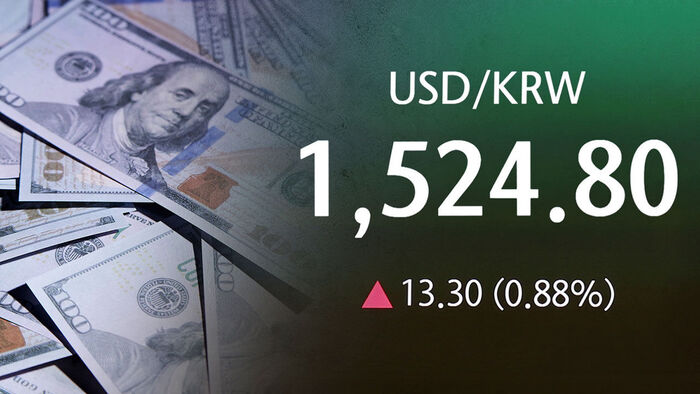
The won-dollar exchange rate closed at 1,524 won today (June 10), up 12 won from yesterday. As the high exchange rate continues to hover above the 1,500-won level for 17 consecutive trading days, authorities have launched a joint foreign exchange inspection for the first time in 14 years.
They are particularly focusing on whether there is speculative activity in the offshore non-deliverable forward (NDF) market. Reporter Min Gyeongho explains why in detail.
[Reporter]
What foreign exchange authorities have recently identified as a factor in the rising exchange rate is the trading occurring in the NDF market.
This refers to Non-Deliverable Forwards, which are traded offshore.
"Offshore" means outside of Korea, and "forward" means trading based on the future value of currencies, with only the difference in value being settled.
For example, let's say an NDF contract is made to buy 100 dollars at 1,500 won per dollar three months from now.
If the exchange rate rises to 1,550 won after three months, it is a profit since the agreement was to buy at 1,500 won.
In this case, the transaction ends by receiving the difference—50 won multiplied by 100 dollars, which is 5,000 won worth of dollars—from the counterparty, rather than exchanging the principal amount of 100 dollars.
Because settlement is made only in dollars, it is possible to seek profits without actual won, which is why foreign exchange authorities believe it is susceptible to speculative elements.
Whenever speculative forces betting on a rise in the exchange rate make forward contracts, the foreign exchange banks involved buy spot dollars in the domestic market to hedge their risks.
In this case, the more NDF contracts there are, the higher the demand for dollar purchases, which pushes up the exchange rate. The daily average volume of NDF trading in the first quarter of this year was 15.55 billion dollars, an increase of over 27% from the previous quarter.
NDF trading takes place 24 hours a day, and its impact on the exchange rate grows between 2:00 a.m. and 9:00 a.m., when the domestic foreign exchange market is closed, subsequently affecting the domestic market upon its opening.
This is why the Bank of Korea Governor made the following remark.
[Shin Hyun-song / Bank of Korea Governor (May 28): Buying and selling NDFs eventually requires hedging, which then has a ripple effect on the domestic market.... A phenomenon where the tail wags the dog sometimes occurs....]
The Financial Supervisory Service and the Bank of Korea have launched a joint inspection for the first time in 14 years, targeting foreign banks with high volumes of NDF trading.
As the Seoul foreign exchange market is set to begin 24-hour operations starting next month, authorities are also reviewing measures to absorb the demand for NDF trading.
However, with the trend of foreign capital exiting the stock market continuing and tensions in the Middle East persisting, experts predict that a dramatic drop in the exchange rate will not be easy for the time being.
(Video Editing: Kim Jong-tae, Design: Jang Chae-woo)
※ Please note: This article was translated by AI and may contain errors.
Joint Foreign Exchange Inspection Conducted for First Time in 14 Years: Targeting 'Speculative Trading'
By Min Gyeongho | Jun 10, 2026