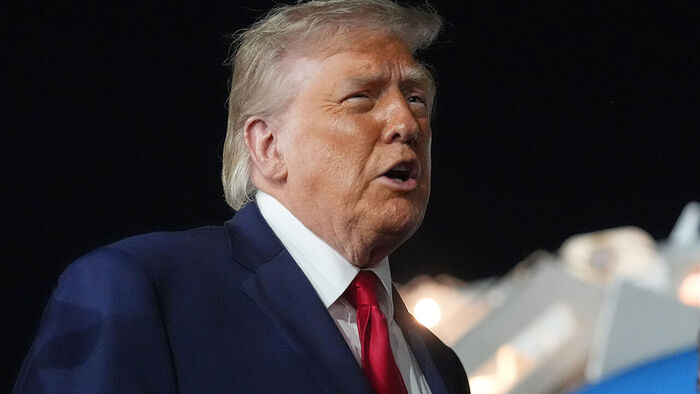
▲ U.S. President Donald Trump
As negotiations to end the U.S.-Iran war, which has passed its 100th day, continue to stall, U.S. President Donald Trump on June 10, local time, raised the possibility of launching a large-scale attack on Iran, which would signal the end of the ceasefire.
During a phone interview with a Fox News reporter on the same day, Trump said he is "getting close" to ordering new airstrikes on Iran's power plants and bridges because Iran "continues to take advantage of" the U.S. during the negotiation process, Fox News reported.
Trump added, "Iran has a chance to sign an agreement to end the war and survive," emphasizing that he could order new airstrikes in response to the Iranian regime dragging its feet at the negotiating table.
Regarding retaliatory strikes on Iranian radar systems and air defense bases following the downing of a U.S. Army Apache helicopter by an Iranian kamikaze drone, Trump said, "Iran tried to rebuild its defense capabilities during the ceasefire, but they could not withstand last night's U.S. airstrikes and were heavily bombarded by U.S. fighter jets."
In a post on his social media platform Truth Social on Wednesday morning, Trump also threatened Iran regarding its negotiating stance, writing, "They have taken far too long to negotiate a deal favorable to them," and adding, "Now they will have to pay the price."
He continued, "Iran is all talk and no action. The bully of the Middle East is dead."
Trump also added, "The Iranian military is a total mess, and much of their navy and air force no longer even exists," claiming, "They have been completely defeated."
Trump's hint at potentially resuming a large-scale offensive against Iran draws significant attention as it follows an exchange of military fire between U.S. and Iranian forces after a U.S. Apache helicopter crashed near the Strait of Hormuz on June 8.
His remarks are interpreted as expressing frustration over the peace negotiations dragging on longer than expected, while simultaneously pressuring Iran to accept U.S. demands for a peace agreement by threatening stronger military action.
In a phone call with the same Fox News reporter on June 7, Trump had previously said that negotiations with Iran were progressing in a direction that could lead to an agreement by Wednesday at the latest.
However, with the downing of the U.S. Apache helicopter by an Iranian drone on Tuesday and the subsequent resumption of military clashes, concerns are rising that not only the peace agreement but also the fragile ceasefire itself could collapse.
Amid a standoff between Iran's blockade of the Strait of Hormuz and the U.S. naval blockade of Iran, Trump had sought to maintain the momentum of negotiations by making his stance on preserving the ceasefire clear during sporadic clashes since last month.
However, as plans for a memorandum of understanding to end the war—centered on extending the ceasefire by 60 days and initiating denuclearization talks—faced domestic opposition, and securing key concessions from Iran regarding the complete reopening of the Strait of Hormuz and denuclearization proved difficult, Trump appears to have put the option of resuming a large-scale offensive against Iran back on the table.
However, questions remain over whether Trump can choose the path of major escalation, given that the war in Iran is closely linked to domestic oil prices and the 2026 FIFA World Cup, co-hosted by the United States, Mexico, and Canada, is set to kick off on June 11.
Meanwhile, Trump reconfirmed during the Fox News interview that it was indeed an Iranian kamikaze drone that shot down the Apache helicopter.
According to Trump's account of the crash, an Iranian unmanned drone collided with the Apache helicopter and became wedged between the two pilots, engulfing the cockpit in intense heat from the drone, which was on the verge of exploding.
Flying at a very low altitude, the pilots brought the helicopter down into the sea within seconds. About two hours later, both pilots were rescued by a U.S. military unmanned surface drone.
Trump described the rescue as a "miracle" and noted that it marked the first time in history that U.S. service members were rescued by an unmanned surface drone, Fox News reported.
(Photo: AP, Yonhap News)
※ Please note: This article was translated by AI and may contain errors.