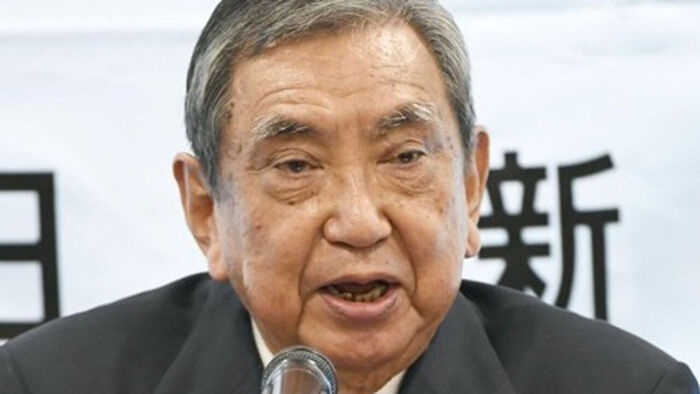
▲ Former Japanese Chief Cabinet Secretary Yohei Kono in 2018
Yohei Kono, the former Speaker of Japan's House of Representatives who issued the landmark 'Kono Statement' expressing apology and remorse over the issue of 'comfort women' during the Japanese colonial period, has passed away at the age of 89.
On Wednesday, Kyodo News and NHK reported that the former speaker passed away on Monday, according to officials.
Kono had maintained a cautious stance on revising Article 9 of the Constitution, which renounces war and bans the possession of war potential, and was widely known as a representative "dove."
He was also evaluated as having placed great importance on relations with neighboring countries, including South Korea and China.
He is well known to South Koreans for issuing the "Kono Statement" on August 4, 1993, during his tenure as Chief Cabinet Secretary, which contained the Japanese government's apology and remorse regarding the issue of military comfort women.
The Kono Statement was the first official declaration by the Japanese government to formally acknowledge that the Japanese military was involved in the recruitment and transfer of comfort women, and that there was coercion in the process.
At the time, the Japanese government conducted an investigation of government documents for one year and seven months, and based on the findings, then-Chief Cabinet Secretary Kono released the statement.
The statement apologized, saying, "The issue of comfort women is one that, with the involvement of the military authorities of that time, severely injured the honor and dignity of many women," and "The Government of Japan extends its sincere apologies and remorse to all those, irrespective of their place of origin, who suffered immeasurable pain and incurable physical and psychological wounds as comfort women."
Since then, there have been multiple attempts by Japanese right-wing groups to revise the statement, but it became the basic stance of the Japanese government after its release, and successive cabinets have generally upheld its spirit.
However, the right-leaning former Prime Minister Shinzo Abe attempted to undermine the sincerity of the statement, claiming that the expression "forcible taking away" was included at the request of the South Korean side.
Additionally, the statement was pointed out as having limitations, as it made no mention of compensation and maintained the stance that legal responsibilities had been settled.
Born in Kanagawa Prefecture, Japan, in 1937, Kono came from a prominent political family.
His father was Ichiro Kono, who served as Minister of Agriculture and Forestry and Minister of Construction; his uncle was Kenzo Kono, who served as President of the House of Councillors; and his eldest son is Taro Kono, a member of parliament who served as Minister for Digital Transformation.
Kono entered politics in the 1967 House of Representatives election, winning a seat under the Liberal Democratic Party (LDP) by inheriting his father's constituency.
He was subsequently re-elected for 14 consecutive terms.
He was elected president of the LDP when the party lost the 1993 House of Representatives election and the Hosokawa cabinet, an opposition coalition cabinet, was launched.
In 2003, he assumed the post of Speaker of the House of Representatives and served for five and a half years.
This is known to be the longest tenure in modern constitutional history.
He did not run in the 2009 election and retired from politics.
He also left a record of never becoming prime minister despite having served as the LDP president.
In 2002, when his hepatitis worsened severely, his eldest son, Taro Kono, donated a portion of his liver for a transplant.
Upon hearing the news of Kono's passing, Japanese Prime Minister Sanae Takaichi expressed her condolences.
Prime Minister Takaichi wrote on her X (formerly Twitter) account, "Mr. Kono made great efforts for the development of national affairs and the establishment of parliamentary democracy at the core of our country's politics for a long time."
She added, "In particular, his attitude of facing historical issues sincerely and emphasizing dialogue and understanding should be remembered as one of the cornerstones of our country's peaceful diplomacy."
(Photo: Yonhap News)
※ Please note: This article was translated by AI and may contain errors.