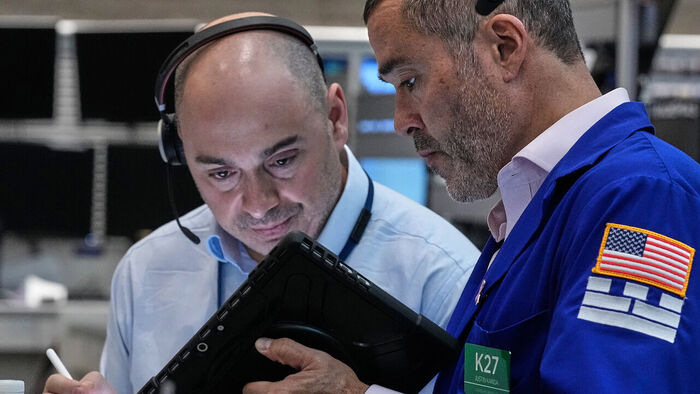
▲ A trader at the New York Stock Exchange
On June 10, local time, Wall Street closed sharply lower as military tensions between the United States and Iran escalated again, and profit-taking sell-offs hit artificial intelligence (AI) semiconductor and tech stocks.
On the New York Stock Exchange, the Dow Jones Industrial Average fell 953.33 points, or 1.87 percent, from the previous session to close at 49,918.78.
The S&P 500 Index closed at 7,266.99, down 119.66 points, or 1.62 percent, from the previous session.
The tech-heavy Nasdaq Composite Index finished at 25,169.50, down 509.32 points, or 1.98 percent, from the previous session.
Wall Street recorded its first back-to-back daily decline in three weeks as concerns over the overvaluation of AI-related stocks were compounded by negative news from the Middle East.
Semiconductor and AI-related stocks, which had driven the recent stock market rally, fell sharply again, leading the overall decline.
AI bellwether Nvidia fell 3.4 percent, while Micron Technology dropped 4.7 percent.
The Philadelphia Semiconductor Index fell 3.6 percent.
In particular, AI server manufacturer Super Micro Computer (SMCI) plummeted 23.1 percent after announcing plans to issue $7 billion worth of shares to secure funds for purchasing components.
The $7 billion is equivalent to approximately 9.5 trillion won.
Some analysts also suggested that investors are reducing their exposure to tech stocks to secure cash ahead of SpaceX's initial public offering (IPO) scheduled for June 12.
Instability in the Middle East also dampened investor sentiment.
U.S. President Donald Trump warned on Truth Social that day, referring to overnight clashes with Iran, that "there will be a price to pay," and later added, "We will hit Iran even harder."
Iranian President Masoud Pezeshkian also announced a strong response policy, heightening the sense of crisis.
International oil prices rose amid fears of a conflict between the two nations.
Brent crude futures for August delivery settled 1.80 percent higher at $93.10 per barrel.
U.S. West Texas Intermediate (WTI) crude futures for July delivery closed up 2.07 percent at $90.03 per barrel.
The U.S. consumer price index (CPI) for May, released in the morning, also fueled market caution over inflation.
The U.S. CPI for May rose 4.2 percent from a year earlier, marking the largest increase in three years.
The core CPI, which excludes volatile food and energy prices, rose 0.2 percent from the previous month and 2.9 percent from a year earlier, meeting market expectations.
However, concerns grew that rising oil prices could prolong future inflationary pressures.
Analysts say the market is showing moves to price in the possibility that the Federal Reserve will raise its benchmark interest rate at least once by the end of the year.
The bond market reflected concerns over long-term inflation.
The yield on the benchmark 10-year U.S. Treasury note rose 3 basis points to 4.55 percent.
The yield on the policy-sensitive 2-year U.S. Treasury note fell slightly to 4.12 percent.
Gold, a safe-haven asset, also weakened.
Spot gold prices plummeted 4.3 percent to $4,077.91 per ounce.
The drop is attributed to the weakening investment appeal of non-yielding gold amid concerns over inflation driven by rising oil prices and potential further interest rate hikes.
Chris Zaccarelli, chief investment officer (CIO) of Northlight Asset Management, said, "If the current tensions in the Middle East persist or worsen, all optimistic inflation forecasts in the market will go awry," adding, "Rising energy prices could block the downward trend in inflation."
(Photo: AP, Yonhap News)
※ Please note: This article was translated by AI and may contain errors.