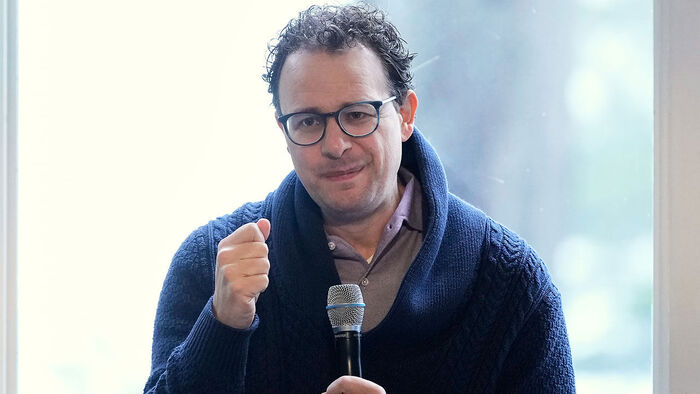
▲ Dario Amodei, CEO of Anthropic
Anthropic, the developer of the artificial intelligence (AI) model 'Claude,' has called for strong government regulation and labor market measures in response to the explosive advancement of AI technology.
Dario Amodei, CEO of Anthropic, outlined his specific stance on the risks of AI and future policy directions through an official statement, a personal blog post, and an interview with Bloomberg on June 10 (local time).
He warned that as AI advances exponentially, it will evolve into a level of "a nation of geniuses in data centers" within one to two years.
He emphasized that simple "transparency," which was discussed in the past, is no longer sufficient to regulate AI. He argued for the establishment of a stricter and more binding federal regulatory agency, modeled after the Federal Aviation Administration (FAA), which conducts technical inspections for aircraft.
Furthermore, he added that until strict federal laws are passed by Congress, state-level independent AI regulations should not be blocked, and Congress should legally require independent safety testing for the top-tier models of AI companies.
Regarding the long-term job displacement that AI will trigger, he urged caution, stating that it is "not only undesirable but also very dangerous."
To address this, he suggested that incentives for companies to promote employment or direct income support systems, such as "universal basic income," would be necessary.
He also advocated for a ban on the use of fully autonomous weapons systems in the United States, reiterating that even if AI is used for military purposes, human intervention must be mandatory.
He drew a line regarding whether 'Claude' was used in the missile strike on an Iranian elementary school in February that resulted in the deaths of over 120 children, stating that he does not know.
However, he explained, "Our principle is that humans make the final decision," adding that the incident is an example of why human control is important even when assisted by AI.
He stated that Claude is not currently being used for the Trump administration's immigration enforcement or in the Gaza Strip, and that its scope is being carefully limited. However, he expressed the view that the use of Claude in U.S. Department of Defense military operations is not a problem in itself.
When asked, "Is it okay that Claude is helping to kill more people faster?" he replied, "Essentially, you are asking, 'Do you believe in this country (the U.S.)?'" He added that as a patriot, he wants the U.S. to be a stronger actor on the world stage and believes that military policy should ultimately be left in the hands of military decision-makers.
He also explained why the public release of the top-tier model 'Mythos,' which raised concerns due to its expert-level ability to detect security vulnerabilities, has been delayed.
CEO Amodei noted that the leap in the model's capabilities was particularly significant, stating, "Among early corporate users, there was a reaction saying, 'This is a super-powerful weapon that requires a gun license, so please do not release it.'"
He explained that while the delay in release caused a significant commercial hit, the company could afford to endure it because it was in a leading position in the industry.
When asked if his path of consistently warning about risks while developing AI models resembles that of J. Robert Oppenheimer, the physicist who developed the atomic bomb, CEO Amodei emphasized, "Oppenheimer is a failure case, a case that should not have happened," adding, "To have a good ending, there must be checks and balances everywhere."
(Photo: AP, Yonhap News)
※ Please note: This article was translated by AI and may contain errors.