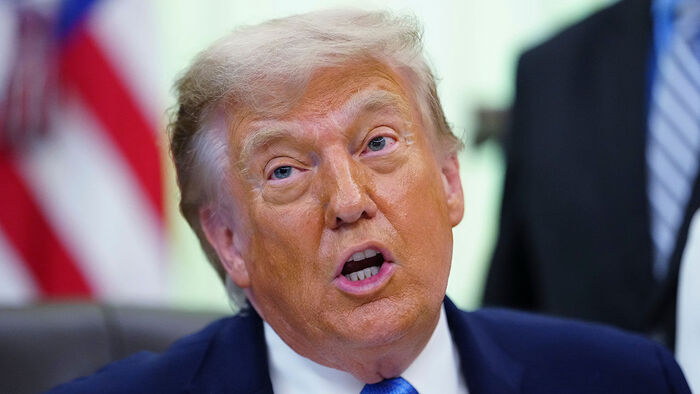
▲ U.S. President Donald Trump speaks in the Oval Office at the White House on June 10 (local time).
U.S. President Donald Trump has stated that he has no intention of extending the United States-Mexico-Canada Agreement (USMCA).
Speaking to reporters at the White House on June 10 (local time), President Trump said, "I have no interest in extending it," adding, "We don't need what Canada or Mexico has, but they need everything we have. They have to treat us better."
Bloomberg reported that President Trump's remarks signal the beginning of what could be months or years of negotiations regarding the USMCA.
The USMCA, which replaced the North American Free Trade Agreement (NAFTA), was reached in 2018 during the first Trump administration and took effect in 2020 after some revisions.
As the largest trade agreement in North America, it is primarily based on duty-free trade.
Under a sunset clause, the agreement must be reviewed every six years, with a decision on whether to extend it required by July 1 of this year.
If an extension is agreed upon, the agreement is reset for another 16 years. Even if an extension is not reached, the agreement can remain in effect for up to 10 more years through annual reviews.
However, the agreement would terminate if any one of the countries declares a full withdrawal.
Since his reelection, President Trump has heightened trade tensions with neighboring countries, leading to low expectations that the agreement would be extended.
The United States and Mexico are scheduled to hold talks regarding the agreement this month and plan to hold additional meetings in July, while the United States and Canada have not yet begun official negotiations.
Mexico and Canada are the United States' largest trading partners, with annual trade volume reaching approximately $2 trillion.
President Trump did not mention whether he intends to withdraw from the USMCA entirely, and the Office of the United States Trade Representative has not provided a clear answer on whether it plans to renegotiate the terms contained in the USMCA.
The Mexican government argues that it is at a disadvantage, noting that the average effective tariff rate on its automobiles exported to the U.S. is 18.75%, which is higher than the 15% applied to automobiles from South Korea and Japan.
(Photo: AP, Yonhap News)
※ Please note: This article was translated by AI and may contain errors.