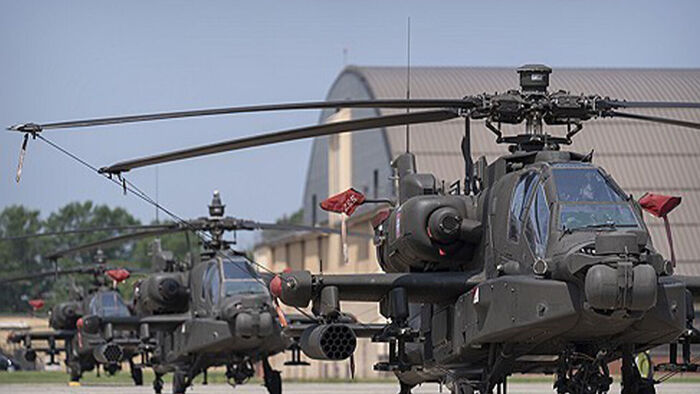
▲ A U.S. Army Apache helicopter
The United States notified Iran that its retaliatory airstrikes for the downing of an Apache helicopter would target only military facilities and result in no casualties, the U.S. news outlet Axios reported on June 10 (local time).
While the military clash over the downed helicopter has raised concerns that the fragile truce between the two sides is in further jeopardy, analysts suggest that both parties are limiting the scope and intensity of their attacks to prevent the collapse of ongoing peace negotiations.
According to Axios, the White House sent a message to Iran around 5:00 p.m. Eastern Time on June 9, while U.S. fighter jets were already in the air, stating that the strikes would be confined to military targets.
A senior White House official stated, "We told the Iranians that if the pilots had died, the situation today would be completely different."
White House sources explained that while the collision between the U.S. military helicopter and the drone may have been accidental, the U.S. needed to demonstrate that it would not tolerate such actions by Iran in the Strait of Hormuz, while simultaneously drawing a line against further escalation.
These officials reaffirmed the U.S. position that the airstrikes were a "proportionate and precise response."
In fact, the U.S. targeted Iranian radar and drone control systems, and there have been no reports of casualties on the Iranian side.
Some interpret the backdrop of these strikes as stemming not only from the helicopter incident but also from President Donald Trump's growing frustration over Iran's delayed response to negotiations regarding a "peace MOU."
President Trump presented a revised peace proposal to Iran late last month and had been waiting for a response for about two weeks, but Iran failed to provide a final position, leading to concerns that the President's patience was wearing thin.
The revised proposal reportedly included requirements for Iran to dilute its enriched uranium within 60 days of signing the Memorandum of Understanding (MOU) and to pledge not to impose tolls in the Strait of Hormuz.
In return, Axios reported that President Trump was willing to accept the dilution of highly enriched uranium within Iranian territory under the supervision of the International Atomic Energy Agency (IAEA).
This is seen as a significant concession from the previous U.S. stance, which had demanded that Iran ship its approximately 440 kg of 60%-enriched uranium out of the country.
Even amidst the military clashes between the U.S. and Iran, behind-the-scenes mediation efforts have continued.
According to reports from AFP and CNN, a Qatari delegation mediating between the U.S. and Iran departed Tehran on the morning of June 11 (Tehran time) after concluding talks with Iranian officials.
A diplomat who requested anonymity told AFP, "The Qatari delegation left Tehran this morning after concluding meetings with Iranian officials," adding that "the talks continued until the early hours of this morning."
The diplomat further noted that "the talks were conducted in coordination with the United States."
(Photo: AP, Yonhap News)
※ Please note: This article was translated by AI and may contain errors.