[Anchor]
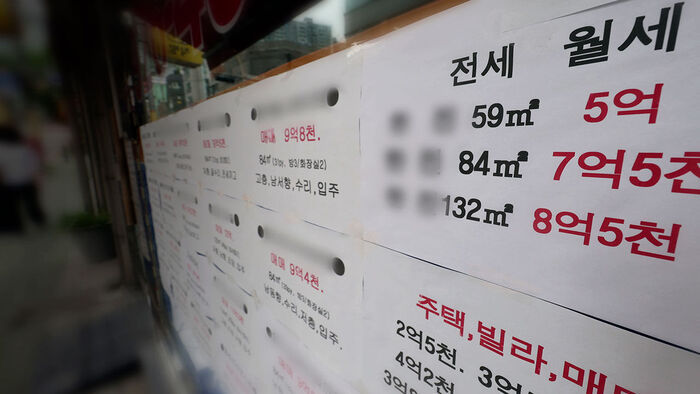
As the shortage of *jeonse* (long-term lump-sum deposit rental) homes in Seoul intensifies by the day, the weekly growth rate of apartment *jeonse* prices in the city has hit its highest level in 10 years and 8 months. While the number of available *jeonse* listings is shrinking, demand from those seeking such rentals continues to pile up.
Reporter Baek Woon has the story.
[Reporter]
An apartment complex in Seongdong-gu, Seoul.
Out of 2,100 households, there are only two *jeonse* listings available.
[Real Estate Agent in Seongdong-gu, Seoul: Because there is no supply, they are asking for high prices. Landlords also believe they can get these prices since there is no inventory. It keeps going up.]
The *jeonse* price for a 59-square-meter unit, which traded at 570 million won in mid-April, reached 620 million won late last month and has since jumped to 700 million won this month.
Similar phenomena are occurring across Seoul.
In the second week of June, *jeonse* prices for apartments in Seoul rose 0.32% from the previous week, marking the highest growth rate in 10 years and 8 months since October 2015.
Seongdong-gu saw the sharpest increase at 0.64%, with steep rises also observed in large complexes in districts such as Dobong-gu and Songpa-gu.
[Ham Young-jin / Head of Real Estate Research Lab at Woori Bank: Since the mandatory residency requirements are effectively leading to a decrease in *jeonse* supply, a rise in *jeonse* prices appears inevitable for the time being...]
Statistics recently showed that the proportion of *jeonse* among Seoul apartment rentals has fallen to 50.2% from 65.6% in April 2017, a decline over nine years, fueling ongoing debate over how to interpret this reduction.
On June 8, President Lee Jae-myung stated that it is natural for *jeonse* supply to decrease as existing rental properties enter the sales market following the end of the grace period for heavy capital gains taxes on multi-home owners, calling it part of a normalization process. However, Seoul Mayor Oh Se-hoon criticized this, stating, "The supply reduction is accelerating much faster due to the government's harsh regulations."
In response, the Ministry of Land, Infrastructure and Transport explained today (June 11) that the primary cause was the decline in new housing starts between 2022 and 2024, driven by the real estate project financing (PF) crisis and soaring construction costs.
Reported by Choi Ho-jun | Video by Kim Jong-mi | Graphics by Lee Yeon-jun
※ Please note: This article was translated by AI and may contain errors.
Seoul Apartment Jeonse Prices See Largest Jump in 10 Years and 8 Months... "Continued Rise Expected"
Jun 11, 2026