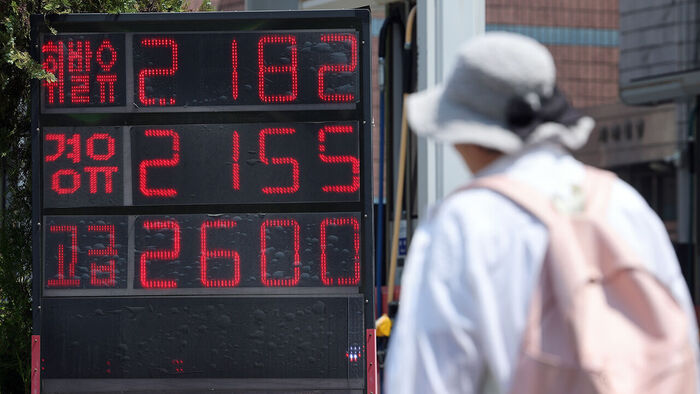
▲ A gas station in downtown Seoul on June 2
The South Korean government has assessed that the domestic economy is maintaining its recovery trend despite uncertainties surrounding the war in the Middle East.
However, it warned that the aftermath of the Middle East conflict could exacerbate difficulties in areas closely tied to public livelihoods, such as inflation and employment.
On June 12, the Ministry of Economy and Finance stated in the June issue of its monthly economic report, the "Green Book," that "while our economy continues its recovery trend driven by robust exports and improving consumer and business sentiment, there are concerns over burdens on public livelihoods, such as rising inflation and a slowdown in employment, amid persistent uncertainties from the war in the Middle East."
In this assessment, the phrase "downside risks to the economy," which had appeared for three consecutive months since the March issue with increasing emphasis, was omitted.
This appears to reflect the recent trend of major domestic and international institutions, such as the Korea Development Institute (KDI) and the Organisation for Economic Co-operation and Development (OECD), raising their economic growth forecasts for South Korea this year.
Instead, in the area of public livelihoods, concerns over "rising inflation" due to high oil prices have been compounded by the possibility of an "employment slowdown."
The term "employment slowdown" was used for the first time since the January issue of last year, which was affected by the aftermath of the martial law declaration.
Indeed, the impact of the Middle East war is becoming increasingly visible in livelihood indicators such as inflation and employment.
In May, consumer prices rose 3.1 percent from a year earlier, accelerating from a 2.6 percent increase in the previous month.
In particular, petroleum product prices, which are directly affected by the Middle East conflict, surged 24.2 percent.
Core inflation, which excludes food and energy, also rose 2.5 percent, widening its gain from the previous month's 2.2 percent.
Employment indicators, which tend to lag behind economic cycles, also showed a slowing trend.
In May, the number of employed people stood at 29.16 million, down 40,000 from a year earlier.
This marks the first decline in the number of employed people in 17 months, since December 2024.
Industrial production (-0.6 percent), facility investment (-3.6 percent), and retail sales (-3.6 percent) in April all declined simultaneously.
The government, however, believes that positive trends centered on consumption and exports are continuing.
In May, the Composite Consumer Sentiment Index (CCSI) rose 6.9 points from the previous month to 106.1, surpassing the benchmark of 100.
During the same month, credit card spending at department stores increased by 17.1 percent, maintaining double-digit growth.
Exports also showed robust growth, led by semiconductors.
Total exports in May surged 53.2 percent year-on-year, with computer exports (290.7 percent) and semiconductor exports (169.4 percent) posting sharp increases.
Regarding the impact of the won-dollar exchange rate remaining in the 1,500-won range, an official from the Ministry of Economy and Finance said, "Theoretically, it can affect import prices. We are putting all our efforts into addressing rising inflation, which is occurring alongside rising oil prices."
The official added, "It appears that the one-sided movement of the exchange rate is accelerating due to speculative movements on top of foreign investors' portfolio rebalancing and profit-taking (in the domestic stock market). We will also make efforts to stabilize the exchange rate."
Regarding the global economy, the ministry analyzed, "While it continues to grow moderately, there are concerns over increased volatility in international financial markets and energy prices due to the war in the Middle East, as well as supply chain disruptions, rising inflationary pressures, and a slowdown in growth."
(Photo: Yonhap News)
※ Please note: This article was translated by AI and may contain errors.