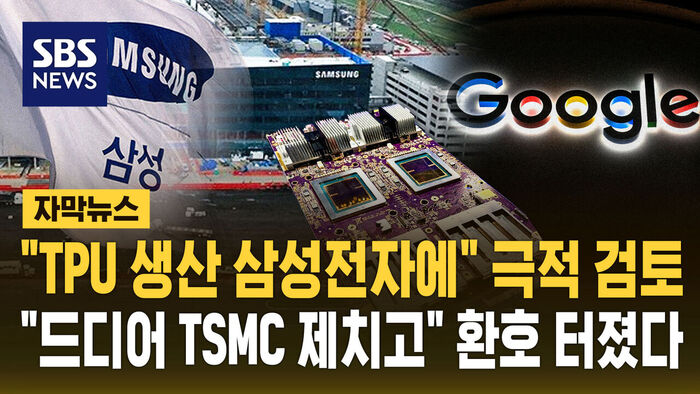
Google is reportedly considering outsourcing part of the production process for its next-generation AI semiconductor chips to Samsung Electronics.
The Information, a U.S. IT news outlet, cited multiple sources reporting that Google is weighing the option of entrusting the production of key components for its 10th-generation Tensor Processing Unit (TPU) to Samsung Electronics' foundry division.
Google is developing this TPU, codenamed "Icefish," with the goal of mass production by 2028.
While TPUs have historically been used to power Google’s internal systems, the company has recently been increasing production volumes as it expands supply to external customers.
The production plan under discussion involves splitting the work between TSMC and Samsung Electronics. In this scenario, TSMC would produce the main processor responsible for computation using a 1.4-nanometer process, while Samsung Electronics would produce the key components that connect High Bandwidth Memory (HBM).
Google's consideration of Samsung appears to be driven by the fact that Samsung Electronics possesses a deep understanding of the characteristics and specifications of memory, including HBM.
Analysts also point to the significance of supply chain restructuring, noting that relying solely on TSMC for foundry services poses significant risks as TSMC's production capacity nears its limits.
Google is currently also considering placing chip orders with Intel.
If the order is secured, it is expected to be a major boost for Samsung Electronics.
Samsung's foundry division has struggled to narrow the gap with TSMC and secure a diverse customer base. However, with the recent surge in semiconductor demand, there are forecasts that the foundry division could reach profitability sooner than expected.
Samsung Electronics has recently secured a series of major contracts, including a deal worth $16.5 billion (approximately 25 trillion KRW) last year to produce next-generation AI chips for Tesla, as well as an agreement to produce language processing units for Groq, which will be integrated into the Nvidia platform.
Reported by Kim Minjeong | Video by Jang Yu-jin | Graphics by Yang Hye-min | Produced by SBS Digital News
※ Please note: This article was translated by AI and may contain errors.
Google Reportedly Considers Samsung for Next-Gen AI Chip Production
By Kim Minjeong | Jun 12, 2026