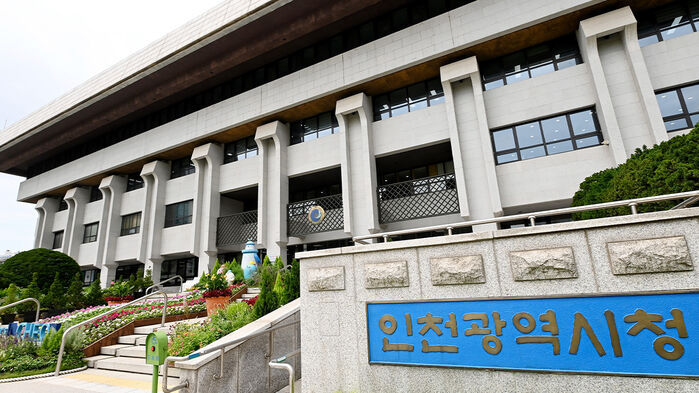
▲ Incheon City Hall
Incheon has been officially selected as the host for the "Defense Innovation Cluster" project promoted by the Defense Acquisition Program Administration (DAPA).
This large-scale national project will span five years starting in 2026, with a total budget of 49 billion won, equally funded by the central and local governments at 24.5 billion won each.
The city plans to complete an "Incheon Defense Belt" by expanding the cluster to include the southern region (Songdo), which hosts the Namdong National Industrial Complex, and the northern region (Bupyeong, etc.), which includes the Bupyeong National Industrial Complex.
The core specialized fields for this project are "Edge AI," which will change the landscape of modern and future warfare, and next-generation "Counter-Unmanned Aircraft Systems (C-UAS)." Edge AI is a technology that processes data in real-time on-site without going through a central server.
The city plans to focus on fostering these two key high-tech areas: the Manned-Unmanned Teaming (MUM-T) system and C-UAS, which have emerged as top security priorities following the recent wars between Russia and Ukraine, as well as tensions between the U.S. and Iran, due to the rise of suicide drones, swarm drones, and illegal unmanned aerial vehicles.
In particular, Incheon is geographically significant as it borders the Northern Limit Line (NLL) and houses critical national infrastructure such as airports, seaports, and energy facilities. As the city with the second-highest Gross Regional Domestic Product (GRDP) in the country, it also possesses a robust high-tech industrial base centered around the Incheon Free Economic Zone (IFEZ).
The city is considered a key region in the capital area capable of building a local defense ecosystem, supported by 14,000 manufacturing companies across 15 industrial complexes, defense support organizations like the Incheon Defense Venture Center, research support facilities such as the Aerospace Industry-Academia Convergence Institute and Incheon Technopark, and testing and verification institutions like the Aviation Safety Technology Institute.
The economic impact of establishing this cluster is estimated to include 116.2 billion won in production inducement, 44.9 billion won in value-added inducement, and the creation of 626 high-quality jobs.
Lee Han-nam, Director of the Marine and Aviation Bureau of Incheon, stated, "The defense industry is no longer just about manufacturing weapons; it is a culmination of advanced IT and aerospace technology. The selection for this Defense Innovation Cluster will serve as a milestone for Incheon to leap forward as a core city that leads both South Korea's national security and future industries."
(Photo: Courtesy of Incheon City, Yonhap News)
※ Please note: This article was translated by AI and may contain errors.