
On June 13, SBS's 'Unanswered Questions' (hereinafter 'Unanswered Questions') broadcast an episode subtitled 'Spy War - Black and White Battlefield: Shadow Chasers,' shedding light on the breathtaking spy chases by National Intelligence Service (NIS) agents in the heart of Seoul and the counterintelligence investigations of the National Police Agency.
In the broadcast, the show tracked 'Black Agent X' from an unnamed country who disguised his identity as a researcher. The production team accompanied NIS counterintelligence agents on their operation to discover why he entered South Korea and what his secret mission was.
Previously, an unprecedented leak of classified information occurred. A 'white agent' (declared intelligence officer) from Country A, who entered through the embassy, met with a Mr. Kim, a former member of South Korea's military intelligence agency. Kim traded military secrets for money. Shockingly, the list of active agents was also leaked during this process.
The NIS set up various cover locations to track Kim's movements. During this process, they focused on his contact with a Mr. Park, Kim's junior from the military intelligence agency who was an active intelligence agent at the time.
Kim, who was adept at hiding his identity, met Park in crowded places. Park transferred military secrets secretly photographed inside his military unit onto his mobile phone and handed them to Kim. Kim copied them into a notebook and immediately erased any traces.
The military secrets collected in this manner were handed over to an official from Country A's embassy in exchange for money. For five years, Kim passed hundreds of military secrets received from Park to the official from Country A. In 2016, he also handed over a list of South Korean military intelligence black agents operating in Country B to Country B's intelligence agency.
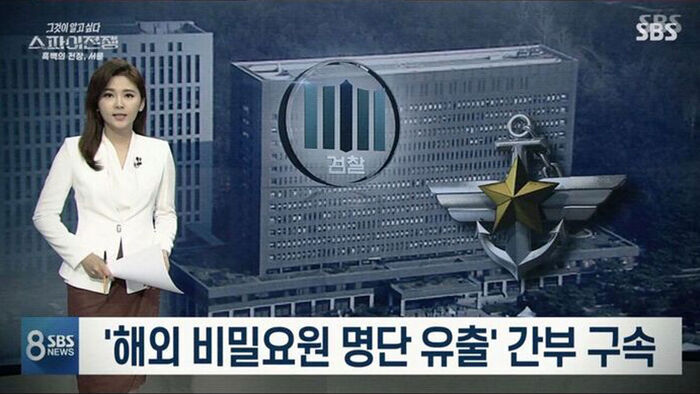
Upon realizing the severity of the situation, the NIS confirmed the safety of its agents and launched an investigation into Park, who had leaked the military secrets.
Normally, such cases end with disciplinary actions like dismissal due to operational security. However, Park contested the disciplinary action, and after appeals and re-appeals, a formal investigation was requested. Ultimately, Park was sentenced to four years in prison and fined 10 million won for general treason and violating the Military Classified Information Protection Act. Kim was also sentenced to four years in prison, with the charge of offering bribes added. The NIS lodged a protest against Country A, leading to the voluntary departure of two diplomats from Country A.
However, the money Kim received for handing over military secrets amounted to a mere 6.7 million won over five years, raising questions. Kim was a decorated individual who had dedicated his life to the country. It was revealed that he continued intelligence activities even after his retirement.
The production team met Kim in person to ask if there were reasons other than money. Kim, who said he was holding his tongue despite feeling wronged, claimed that the money was not a bribe but merely a courtesy. He also appealed his sense of injustice, claiming that he had no choice but to hand over the military secrets because his safety was threatened during his intelligence work, and lamented that the state did not recognize his contributions.

However, an expert pointed out, "Among the leaked items was the list of black agents. Both countries build spy networks centered around embassies or military attachés, and if the list is compromised, the intelligence network collapses. It is fatal."
Why, then, do so many intelligence agents conduct operations in South Korea?
An expert explained, "Due to its geopolitical characteristics, foreign intelligence agencies strongly tend to view South Korea as an outpost. They can gather information on neighboring countries and North Korea, and unlike operating in places like China or Russia, there are fewer deterrents, allowing them to operate more freely."
Another expert said, "The largest number of spies in East Asia are in South Korea. A former diplomat once mentioned that there might be around 300,000 agents active in South Korea."
The expert added, "SIGINT (signals intelligence) is not information you can get immediately by going into the field. South Korea possesses the most HUMINT (human intelligence) on North Korea," pointing to HUMINT as one of the key reasons why so many agents operate in South Korea.

Indeed, North Korean defectors receive HUMINT proposals from various countries. Nations curious about and interested in diverse information on North Korea have been purchasing intelligence, paying anywhere from tens of thousands of won to tens of millions of won.
It drew attention when it was revealed that defectors are actually making video calls via Chinese messaging apps with people in the North Korean border areas. They are reportedly contacting South Korea using Chinese mobile phones through Chinese base stations.
The broadcast also depicted agents chasing industrial technology leaks. The Industrial Technology Security Investigation Unit of the Seoul Metropolitan Police Agency arrested an individual caught red-handed attempting to flee the country with proprietary technology, in violation of the Unfair Competition Prevention Act.
A semiconductor development company requested the arrest of an employee who was fleeing the country with technology for manufacturing capillary equipment. With only 50 minutes left before the suspect's flight, the investigation team rushed to the airport and apprehended them. The suspect, the first in an industrial espionage case to be arrested without a warrant, was later indicted and detained after investigations uncovered evidence of technology leakage and accomplices.
Samsung Electronics suffered significant damage from an industrial technology leak in 2020. An official stated that while gathering Voice of Customer (VOC) feedback from partner companies, they received a tip-off that "former employees had left to start their own company, replicated the semiconductor cleaning equipment, and were selling it abroad," which they immediately reported to the NIS. The semiconductor cleaning equipment, developed for the first time in the world in 2014, was recognized as a national core technology.
After leaving the company, the suspect established a semiconductor equipment firm and attempted to attract foreign investment. When that failed, they sought a breakthrough using the victim company's technology. They recruited not only former employees of the victim company but also employees of partner companies that had non-disclosure agreements and shared technical data with the victim company.
Once the leak route and scope were identified, investigations confirmed that the suspects had produced prototypes using the leaked technology, exported them to competitors, and handed over the cleaning equipment technology to a foreign firm with intentions to establish a local joint venture. Consequently, the suspect was sentenced to 10 years in prison.
However, the suspect's brother protested, asking, "How is manufacturing and selling equipment considered a technology leak?" Yet, once the state designates something as a national core technology, any export, corporate acquisition, or merger requires state approval, which the suspect failed to obtain.
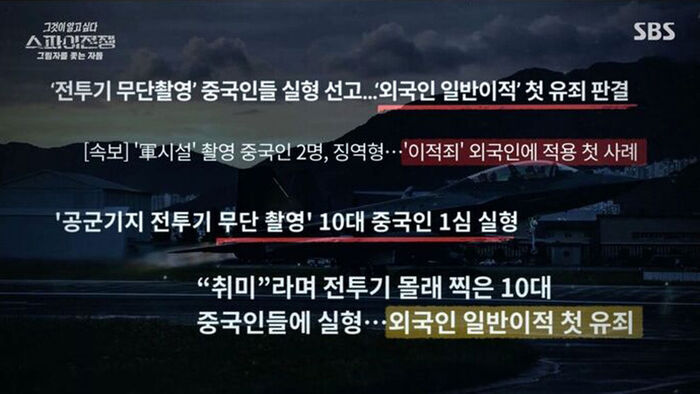
A resident reported witnessing Chinese high school students photographing the Suwon Air Base, where the U.S. Air Force is stationed, using telephoto lenses. They were arrested following the report.
Their cameras contained hundreds of photos of fighter jets taken while traveling to military airfields across South Korea. They drew attention by remaining remarkably calm during the investigation, a composure hard to believe for high school students. In addition to cameras, their bags contained small walkie-talkies.
The suspects claimed they brought the walkie-talkies because they heard they could listen to pilots' radio communications by tuning into the frequencies. However, investigative authorities judged it as "low-intensity intelligence activity," stating it appeared to be part of a hybrid warfare strategy beyond physical warfare in modern society. In an unusual move, they were handed prison sentences in the first-ever conviction of foreigners for general treason.
This is an example of influence operations, which utilize ordinary citizens or teenagers as disposable spies. Recently in the United States, the mayor of an affluent town was arrested on charges of assisting the Chinese government's propaganda efforts by running fake news websites on U.S. soil. What he conducted was precisely an influence operation.
Finally, the agents requested the public's continuous attention, saying, "If the public becomes our eyes and ears and pays close attention, citizens can protect their own safety."
Additionally, a national counterintelligence officer from the NIS drew attention by pledging, "I will dedicate myself to defending national security and national interests."
(Edited by Kim Hyo-jung)
※ Please note: This article was translated by AI and may contain errors.