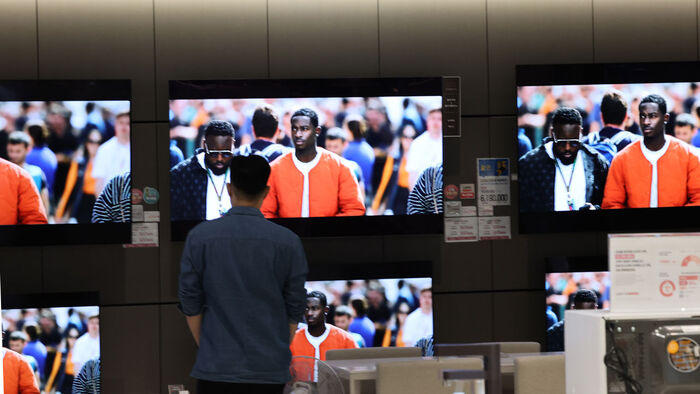
▲ LG Electronics OLED TV
As Chinese companies accelerate their pursuit in the organic light-emitting diode (OLED) sector—the flagship product of South Korea's display industry—a report suggests that policy support must be strengthened to enhance the competitiveness of South Korean firms and secure a foundation for long-term growth.
The report points out that just as South Korea's display industry once held an unrivaled position in the liquid crystal display (LCD) market but ultimately lost its dominance to Chinese competitors backed by massive government support, South Korea must now make life-or-death efforts to defend its supremacy in the OLED market to avoid being overtaken.
According to a report titled "K-OLED Competitiveness and Strategy to Maintain Super-gap" published on June 14 by the Overseas Economic Research Institute of the Export-Import Bank of Korea, South Korea's global OLED market share (combined share of Samsung Display and LG Display) stood at 68.7% last year, while China's share was 31.2%.
The market share gap between the two countries has been narrowing since China entered the OLED market in 2015.
In 2020, the gap reached 75.2 percentage points, with South Korea at 87.3% and China at 12.1%. However, it narrowed to 47.9 percentage points in 2023 (South Korea 73.6%, China 25.7%) and further to 34.9 percentage points in 2024 (South Korea 67.2%, China 32.3%).
Market research firm Counterpoint Research recently projected that China's OLED production capacity could overtake South Korea's by 2029.
Chinese companies, including the country's largest display maker BOE, are growing rapidly by leveraging low-cost OLED panels supplied to domestic smartphones.
Last year, South Korea held a 64% share of the small-to-medium OLED panel market used in smartphones and other devices, while China held 35.9%.
The report analyzed that China is closely trailing South Korea in the OLED panel market for information technology (IT) devices, such as laptops and tablets, using the technology it has accumulated through smartphone OLEDs.
The technology gap in IT OLEDs between the two countries, which was estimated at 3 to 4 years in 2023, has now narrowed to about 2 years.
The report analyzed that Chinese companies are applying the same "chicken game" strategy to OLEDs that they previously used to dominate the LCD market with aggressive pricing.
After entering the LCD market dominated by Japan in 1995, South Korea maintained the top spot for 17 years from 2004 to 2020 through continuous technological development and investment expansion. However, it lost the top position after 2021 as Chinese companies, backed by comprehensive support including large-scale government subsidies, launched aggressive low-price volume offensives.
Of course, the report explained that the OLED market will not be as easy to conquer as the LCD market.
Unlike LCDs, where large-scale production capacity and price competitiveness are crucial, OLEDs operate on an order-based business structure, making it difficult to succeed solely through aggressive price pressure.
Another positive factor is that South Korean companies have established a structure to receive legitimate patent licensing fees from Chinese firms.
However, the report emphasized that to effectively counter the rapidly growing Chinese OLED industry, which is backed by unprecedented support from both central and local governments, there is an urgent need to strengthen policy support for research and development (R&D) and facility investment.
It explained that because the display industry is capital-intensive with high facility investment costs and investment risks, government-level support is necessary to maintain technological dominance.
"While there is still a gap in mass-production technology and quality, there is a risk that China will continue aggressive facility investment to increase technological maturity and launch a volume offensive," the report stated. "If South Korea slows down its R&D pace, it could also be overtaken by China in the OLED market."
(Photo: Yonhap News)
※ Please note: This article was translated by AI and may contain errors.