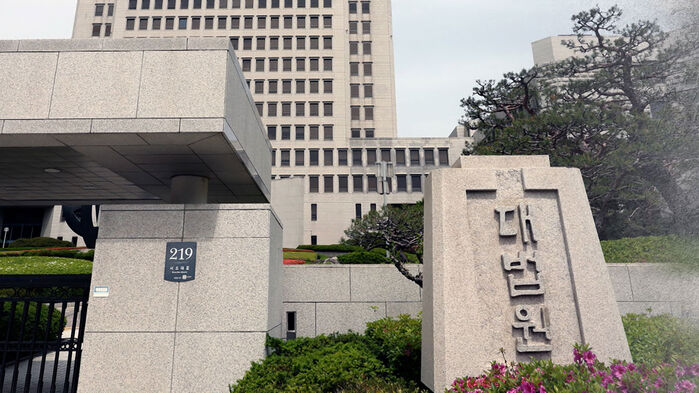
▲ The Supreme Court of Korea
The Supreme Court has ruled that manufacturing companies that operate through outsourcing without maintaining their own manufacturing facilities are not eligible for tax exemptions granted to knowledge industry centers.
The Third Division of the Supreme Court (Justice Lee Sook-yeon presiding) recently overturned a lower court's ruling in favor of the plaintiff in a lawsuit filed by K2 Korea, a manufacturer and retailer of hiking boots and outdoor gear, against the head of Gangnam-gu Office, seeking the cancellation of a refusal to correct acquisition tax. The case has been remanded to the Seoul High Court.
In 2019, K2 Korea constructed a new knowledge industry center in Jagok-dong, Gangnam-gu, Seoul, using part of the space as its headquarters and leasing the rest to small and medium-sized enterprises.
K2 Korea initially paid the acquisition tax but later filed a request for correction, arguing that it was entitled to a partial refund because the facility qualified for tax exemptions under the Restriction of Special Local Taxation Act as a knowledge industry center for manufacturing.
However, tax authorities rejected the request on the grounds that K2 Korea did not possess manufacturing facilities, leading the company to file an administrative lawsuit.
The core issue was whether a manufacturing company that operates via outsourcing without its own production equipment qualifies for tax exemptions for knowledge industry centers under the Restriction of Special Local Taxation Act.
The Restriction of Special Local Taxation Act stipulates that local taxes shall be reduced for "those who establish a knowledge industry center in accordance with the Industrial 집적 (Cluster) Act."
The Industrial Cluster Act defines facilities eligible to move into a knowledge industry center as "facilities for operating manufacturing, knowledge-based industries, information and communications industries, etc."
The first and second trials ruled in favor of K2 Korea.
The lower courts reasoned that the Restriction of Special Local Taxation Act does not explicitly require that a manufacturing business must be a "factory within a knowledge industry center equipped with machinery, equipment, and other manufacturing facilities" to qualify for acquisition tax reductions.
They also cited the fact that under the Korean Standard Industrial Classification, businesses that manufacture products through outsourcing or subcontracting are still classified as manufacturing.
The Supreme Court reached a different conclusion.
The Supreme Court ruled that the term "facilities for operating a manufacturing business" in the relevant laws must be interpreted as referring to a factory equipped with manufacturing facilities, such as machinery and equipment.
The Court based its decision on the fact that the Industrial Cluster Act defines a factory as "a place of business equipped with manufacturing facilities, such as machinery and equipment, and their auxiliary facilities for the purpose of manufacturing."
Furthermore, the Court pointed out that granting tax benefits to manufacturing companies without production facilities would excessively expand the scope of local tax exemptions, leading to difficulties in managing knowledge industry centers and contradicting the purpose of the system.
The Supreme Court emphasized, "Tax laws should be interpreted according to their literal meaning unless there are special circumstances, and they should not be interpreted broadly or by analogy without reasonable grounds." It added, "In particular, provisions that can be clearly seen as preferential treatment among exemption requirements must be interpreted strictly, which is also in line with the principle of tax equity."
※ Please note: This article was translated by AI and may contain errors.