
▲ The scene where a private revenge agency carried out retaliation
A person in their 20s, who fell victim to a secondhand transaction scam worth 10 million won, was threatened after attempting to hire a private revenge agency.
In April, after seeing no progress in the police investigation, the victim, surnamed Lee, searched for "revenge" on the internet and contacted Company A, which advertised retaliation services on Telegram.
Following its own investigation, Company A claimed that the account Lee had deposited money into was a borrowed-name account with a balance of only 80 won, and proposed to track down the account holder to retrieve the money.
When Lee requested the recovery of 60 million won, including compensation for mental distress, the agency explained their criminal methods in detail, saying, "The bastards who sell borrowed-name accounts have no money. We can raise up to 50 million won by forcing the account holders to open burner phones, run daily-interest loan schemes, or take out illegal loans."
The agency then demanded payment through a cryptocurrency platform commonly used on the dark web, under the terms of a "3 million won upfront payment and a 15 million won balance upon recovery."
The method required Lee to sign up for the platform, deposit money into the account, and hand over the ID and password.
However, when Lee grew suspicious and stated, "I will delay the deposit and put the plan on hold," the agency's attitude suddenly changed.
The agency began threatening Lee, saying, "You clearly said to go ahead, so we said we'd send our guys, and now you're talking nonsense. I believe we told you that the next target would be the client."
When Lee responded, "I want to proceed, but I'd like to change the plan because I'm anxious," the agency pressured Lee even harder, saying, "Do you think I can't dig up your personal information? Should I find your ID right now, open a few burner phones under your name, and take out a bunch of loans?"
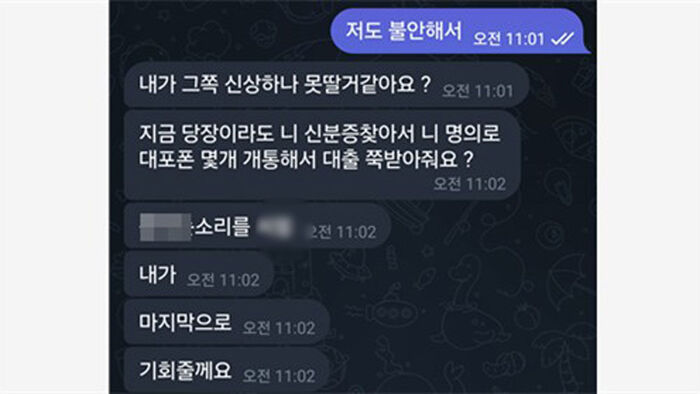
Ultimately, Lee filed a complaint against Company A with the Jinju Police Station in South Gyeongsang Province on charges including intimidation, expressing deep anxiety over what the group might do.
In fact, the agency's Telegram channel openly displayed an introductory post claiming to thoroughly resolve grudges that cannot be settled legally through private punishment.
They demanded the target's personal details for the retaliation. While claiming they do not use physical violence, they listed blocking financial activities, damaging the target's reputation at work and among acquaintances, causing bodily harm disguised as accidents (such as falling from high places), and framing them for crimes as their primary methods of revenge.
Another agency promoted its services by claiming that the reporting rate to investigative authorities is less than 15% and the arrest rate is even lower, even posting a so-called "retaliation price list."
This agency encouraged crime by meticulously setting prices: demanding 1.5 million won to visit the target's address and terrorize them, 1 million won for distributing flyers, 350,000 won for freezing bank accounts, 200,000 won for exposing them via social media comments, and 100,000 won for delivering embarrassing items.
Last month, President Lee Jae-myung strongly warned that "private revenge services are a serious crime," prompting a large-scale police investigation, but these agencies continue to thrive in the shadows.
Following the arrest of the perpetrators who carried out the retaliation, the police are now focusing on tracking down the masterminds of the organizations who control the funds, run private detective agencies, and order the crimes, as well as those who steal personal information.
Meanwhile, according to findings from the police investigation, most of the targets of these private retaliations are reportedly individuals suspected of crimes such as fraud.
(Photo: Telegram capture, Yonhap News)
※ Please note: This article was translated by AI and may contain errors.