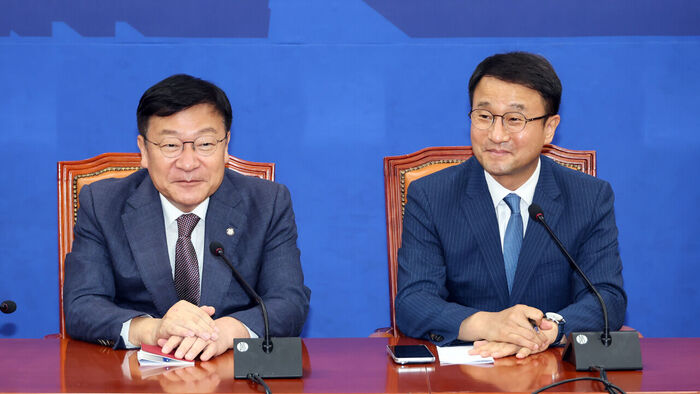
▲ Democratic Party of Korea Floor Leader Han Byung-do (right) meets with the newly elected People Power Party Floor Leader Jeong Jeom-sig, who visited the DPK floor leader's office at the National Assembly on June 11 to offer greetings upon his inauguration.
The ruling and opposition parties will enter full-scale negotiations this week to form the committees for the second half of the 22nd National Assembly.
A fierce clash is expected between the ruling Democratic Party of Korea (DPK), which aims to secure key standing committee chairmanships to support the state administration of the Lee Jae-myung government through legislation, and the main opposition People Power Party (PPP), which argues that the opposition party should lead core standing committees as the second-largest party to keep the government and the ruling party in check.
A war of nerves is already underway over the chairmanship of the Legislation and Judiciary Committee, which acts as a gateway for processing major bills among the 18 standing and permanent special committees and is often referred to as the "upper house" of the National Assembly.
The DPK remains firm in its stance that the ruling party must hold the chairmanship of the Legislation and Judiciary Committee to ensure the swift passage of bills related to public livelihoods and reforms that have cleared various standing committees.
There are concerns that if the PPP takes the chairmanship, it could delay the processing of bills by keeping them pending in the committee.
The PPP is demanding the chairmanship, citing the convention where the National Assembly speaker is from the largest party and the Legislation and Judiciary Committee chairperson is from the second-largest party.
Their logic is that since the ruling coalition has the authority to end filibusters in the plenary session, the opposition party must hold the committee's chairmanship to uphold the democratic principle of checks and balances.
Choi Soo-jin, the chief floor spokesperson of the PPP, issued a commentary on Sunday, June 14, emphasizing, "The only way to follow the solemn public sentiment of the June 3 local elections, which called for preventing the privatization of power, is for the opposition party to secure the chairmanship of the Legislation and Judiciary Committee to fully restore the National Assembly's oversight function."
On the other hand, DPK floor spokesperson Lee Ju-hee countered in a written briefing, saying, "The National Assembly in the second half of its term must address urgent livelihood issues even more swiftly," adding, "We can never hand over the chairmanship of the Legislation and Judiciary Committee to the People Power Party, which has consistently delayed legislation."
Discussions are also expected to be intense over the chairmanships of the National Policy Committee; the Trade, Industry, Energy, Startups, and SMEs Committee; and the Science, ICT, Broadcasting, and Communications Committee.
Within the DPK, there is a strong perception that the Lee Jae-myung government faced constraints in pushing forward its economic policies during the first half of the National Assembly's term because the PPP held the chairmanships of both the National Policy Committee and the Trade, Industry, Energy, Startups, and SMEs Committee.
The argument is that the ruling party must lead the National Policy Committee, which handles real estate-linked financial policies and regulatory legislation, and the Trade, Industry, Energy, Startups, and SMEs Committee, which drives legislation in the industrial, trade, and energy sectors, to expedite "economic legislation."
A sentiment is also detected within the ruling party that the Science, ICT, Broadcasting, and Communications Committee, which is related to broadcasting and telecommunications policies, is a standing committee that cannot be conceded.
The PPP is targeting the chairmanships of the Strategy and Finance Committee and the Land, Infrastructure and Transport Committee to take the initiative in offensives over tax issues and other matters.
Security-related standing committees, such as the Foreign Affairs and Unification Committee and the National Defense Committee, which were chaired by the PPP in the first half of the National Assembly, could also become points of contention during the negotiation process.
As the negotiations for committee formation begin, attention is also focused on who will take up the committee chairmanships.
In the DPK, three-term lawmakers who have no prior experience as government ministers or standing committee chairpersons are expected to take over chairmanships in the second half.
Representatives Kim Jung-ho, Kim Young-jin, Song Ki-hun, Lee Un-ju, Jeon Hyun-hee, and Jin Sung-joon are being mentioned as primary candidates for the ruling party's share of committee chairmanships.
Representatives Seo Sam-seok and Lee Jae-jung, who served as committee chairpersons for only one year instead of the typical two-year term, are also being considered for chairmanships in the second half.
In the PPP, three-term lawmakers are also the main candidates for committee chairmanships.
Among the three-term lawmakers, Representatives Kim Seok-ki, Sung Il-jong, Shin Sung-bum, Yoon Han-hong, and Lee Chul-gyu served as committee chairpersons in the first half, while Representatives Kim Sung-won, Kim Jung-jae, Kim Hee-jung, Song Seog-jun, Song Eon-seok, Lee Man-hee, and Lee Yang-soo have not yet held such positions.
Among the four-term lawmakers, Representatives Ahn Cheol-soo and Yu Eui-dong have not yet served as chairpersons.
While speculation is growing that lawmakers who have not previously served as chairpersons will be prioritized, full-scale discussions on "internal appointments" are expected to begin only after the outline of the negotiation results between the ruling and opposition parties becomes clear.
(Photo: Yonhap News)
※ Please note: This article was translated by AI and may contain errors.