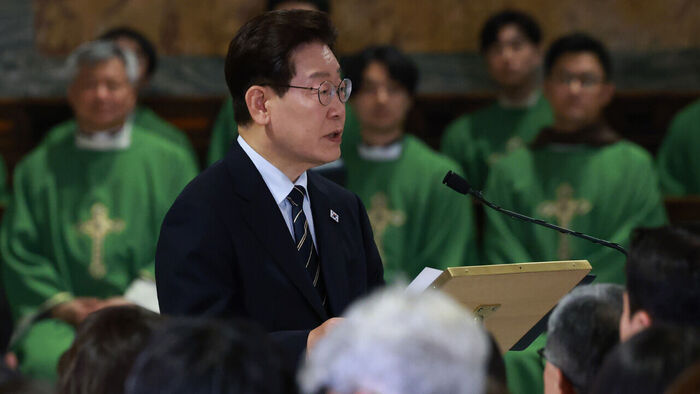
▲ President Lee Jae-myung delivers a commemorative speech at the 'Special Mass for Peace and Solidarity' held at the Basilica of Saint Paul Outside the Walls in Rome, Italy, on the 14th (local time).
President Lee Jae-myung, currently on a tour of Europe, has sent a message that South Korea will contribute to global peace through "peace on the Korean Peninsula," taking the opportunity of his visit to the Holy See.
With progress on dialogue with North Korea remaining elusive, the message is interpreted as a clear signal that he intends to continue his policy of peaceful coexistence into his second year in office, while requesting the interest and cooperation of the international community.
"At a time when conflict and uncertainty weigh heavily on the world, the Republic of Korea wishes to deliver a message of hope," President Lee said during the 'Special Mass for Peace and Solidarity' held at the Basilica of Saint Paul Outside the Walls on this day.
President Lee acknowledged that the current situation on the Korean Peninsula is difficult, stating, "The South and North, which once spoke of peace and prosperity together, have returned to an era of disconnection and confrontation."
However, he made it clear that he would not lose optimism, reminding the audience that South Korea has historically defended peace and democracy despite numerous trials.
In particular, he assessed the June 15th North-South Joint Declaration, achieved during the Kim Dae-jung administration, as a "historical turning point," adding, "I am convinced that the spark of hope still remains alive today."
He emphasized that just as the long-standing hostility and tension between the two Koreas were transformed by the June 15th Joint Declaration, he would continue to seek ways to turn the tide of history without giving up.
This is also interpreted as a gesture of dialogue extended once again toward North Korea.
North Korea, while deepening its ties with China and Russia, has expressed skepticism toward President Lee's policy of peaceful coexistence and has ignored calls for dialogue.
Recently, North Korea even lashed out at a joint statement adopted by South Korea and Europe, which criticized North Korea-Russia military cooperation, claiming that South Korea had "thrown off the mask of peace."
Therefore, analysts suggest that President Lee has once again clarified that the government's policy of peaceful coexistence remains unchanged.
"Since its inauguration last year, the South Korean government has pursued preemptive tension-reduction measures, including the suspension of leaflet scattering and loudspeaker broadcasts toward the North," President Lee emphasized. "We are making it clear that we do not seek absorption unification or unilateral systemic competition."
This appears to be based on the judgment that although conditions are not favorable, there is still room for North Korea to respond to dialogue.
Furthermore, President Lee highlighted that peace on the Korean Peninsula could contribute to global peace.
"At a time when conflict and uncertainty weigh heavily on the world, the Republic of Korea wishes to deliver a message of hope," President Lee said. "I hope we can create a virtuous cycle together, where peace on the Korean Peninsula leads to global peace, and global solidarity, in turn, strengthens peace on the Korean Peninsula."
With the international community's attention focused on the wars in the Middle East and Ukraine, this is interpreted as a call for attention by reminding the world that the Korean Peninsula is also a critical region for global peace.
It is also interpreted as a strategy to secure diplomatic space for South Korea by using peace on the Korean Peninsula as a key theme amidst an unstable international political climate.
(Photo: Yonhap News)
※ Please note: This article was translated by AI and may contain errors.