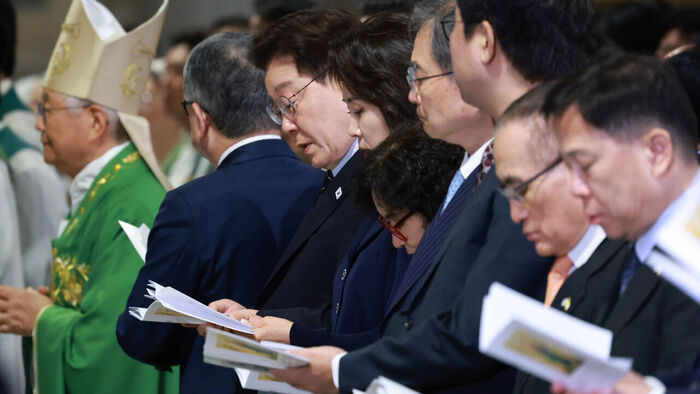
▲ President Lee Jae-myung and First Lady Kim Hye-kyung attend a "Special Mass for Peace and Solidarity" presided over by Cardinal Lazzaro You Heung-sik at the Basilica of Saint Paul Outside the Walls in Rome, Italy, on June 14 (local time).
President Lee Jae-myung, currently on an official visit to the Vatican, said, "Twenty-six years ago on June 15, the South and the North sat down together for the first time since the division of the peninsula and announced the June 15 Joint Declaration," adding, "I firmly believe that the spark of hope is still alive today."
President Lee made the remarks in a commemorative speech during a special Mass at the Basilica of Saint Paul Outside the Walls, stating, "The June 15 Joint Declaration was a historical turning point that signaled to the world the possibility of dialogue and cooperation, moving beyond long-standing hostility and tension."
First, President Lee extended his greetings to Cardinal Lazzaro You Heung-sik and other distinguished guests, saying, "Standing in this holy place where the spirituality of Saint Paul the Apostle lives and breathes, I feel an indescribable sense of reverence."
He continued, "Today, the world is in a state of deeper conflict and uncertainty than ever before. The gunfire of the war in Ukraine has not stopped, and new conflicts continue in the Middle East," diagnosing that "shadows of division and confrontation are casting over various parts of the international community."
In particular, he said, "The Korean Peninsula is by no means free from this reality. The South and the North, which once spoke of peace and prosperity together, have returned to an era of disconnection," adding, "The communication channels that connected the two Koreas have closed, and mistrust and tension remain."
President Lee emphasized that the crisis in inter-Korean relations can also be overcome, saying, "However, the people of the Republic of Korea have a history of firmly overcoming trials and hardships without losing faith in peace and democracy. We developed democracy beyond the era of dictatorship and oppression, and even amidst turbulent waters, we lit up the darkness not with guns and swords, but with candles; not with violence, but with peace; and not with cynicism, but with solidarity."
Specifically, he first noted, "Since its inauguration last year, the government has pursued preemptive measures to ease tensions, including the cessation of leaflet distribution and loudspeaker broadcasts toward North Korea," adding, "We have also clearly stated that we do not pursue unification by absorption or unilateral competition between systems."
He then promised, "We will steadily continue our efforts to prevent accidental clashes between the South and the North and to restore military trust," adding, "We plan to do everything we can to go beyond the armistice state and build a sustainable peace regime."
He also delivered a message of peace to the international community.
President Lee said, "For a long time, the international community has yearned for peace and reconciliation on the Korean Peninsula, and the Republic of Korea has also made steady efforts to meet those expectations and support. I express my deep gratitude to the Holy See for sending its unwavering interest and support."
He continued, "At a time when conflict and uncertainty are weighing heavily on the world, South Korea now delivers a message of hope," pledging, "With the light drawn from democracy, the dignity shaped by our rich culture, and the future possibilities opened up by science, technology, and innovation, we will contribute to creating a world that is more peaceful, free, and where everyone enjoys a life of dignity."
He also stated, "We will join hands with like-minded people across borders, ideologies, races, and cultures to bring reconciliation where there is conflict, trust where there is distrust, and solidarity where there is division, fulfilling our international responsibility to make peace a common heritage of humanity."
He added, "I hope we can together create a virtuous cycle where peace on the Korean Peninsula leads to global peace, and global solidarity in turn strengthens peace on the Korean Peninsula."
President Lee also cited a passage from the biblical Book of Isaiah, "They will beat their swords into plowshares and their spears into pruning hooks," and asked, "Please pray with us so that these precious words can be realized across the entire land."
This is interpreted as emphasizing a world that needs only tools for life, rather than weapons.
Furthermore, regarding the World Youth Day to be held in Seoul next year, he requested the Holy See's interest, saying, "I hope that young people from all over the world can come together, transcending the limitations of front lines, barbed wire, and borders."
President Lee concluded his speech by saying, "Two thousand years ago, Jesus Christ told his trembling disciples, 'Take courage, I have overcome the world.' I hope these words will be delivered to our young people today as comfort, courage, and hope," adding, "I pray that our prayers will also become a blessed grain of wheat for peace and solidarity throughout the world, and I pray that God's grace will be with everyone."
(Photo: Yonhap News)
※ Please note: This article was translated by AI and may contain errors.