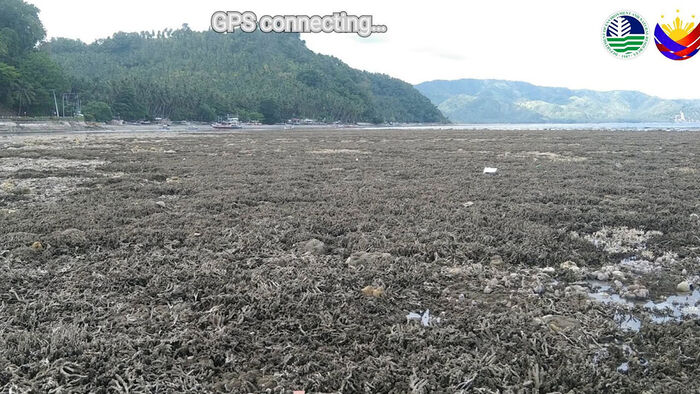
▲ The seabed off the coast of Mindanao, southern Philippines, has risen due to a powerful earthquake, exposing coral reefs and other marine life above the water.
As the death toll from the recent 7.8-magnitude earthquake off the southern coast of the Philippines has risen to 61, with 40 people still missing, it has been reported that the seabed in the affected area has risen by up to 2 meters, leaving it exposed above the water surface.
The Philippine Department of Environment and Natural Resources (DENR) announced on June 14 (local time) that the earthquake caused land uplift in some coastal areas of Sarangani and Davao Oriental provinces on the southern island of Mindanao, near the epicenter.
The department stated that the previously submerged seabed has risen by as much as 2 meters, and that an investigation team dispatched to the site "confirmed that extensive coastlines, coral reefs, and seagrass beds have been exposed" above the water.
Photos released by the department show coral reefs exposed over a wide area, with dead fish and other marine life scattered across the surface.
Consequently, the department reported that the coastline has been altered in some areas, with the shoreline shifting up to 200 meters from its original position.
The Philippine Institute of Volcanology and Seismology (PHIVOLCS) explained that this phenomenon occurred as the Cotabato Trench, located near the epicenter, shifted during the earthquake.
Meanwhile, the National Disaster Risk Reduction and Management Council (NDRRMC) of the Philippines announced that the powerful earthquake, which struck the southern coast of Mindanao on June 8, has resulted in 61 deaths, 40 missing, and 1,403 injuries to date.
(Photo: Captured from the Philippine Department of Environment and Natural Resources Facebook page, Yonhap News)
※ Please note: This article was translated by AI and may contain errors.