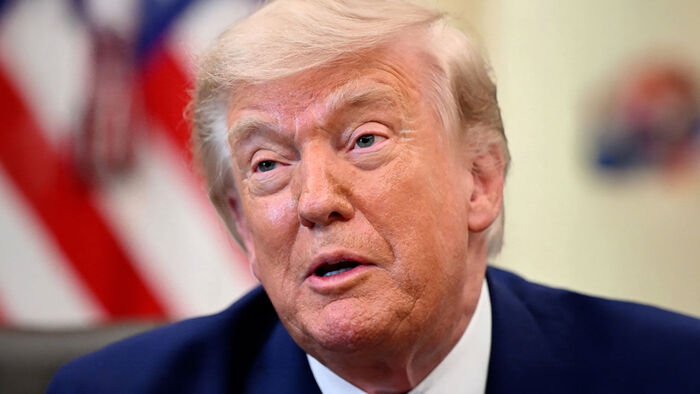
▲ U.S. President Donald Trump
As an agreement between the United States and Iran regarding the end of hostilities and denuclearization appears imminent, armed conflict surrounding Lebanon has emerged as a new variable.
U.S. President Donald Trump, who announced the previous day that he planned to sign the agreement with Iran on June 14—his 80th birthday—has moved to prevent any negative impact on the deal. In an unusual move, he criticized Israel's strike near Beirut and urged all parties to exercise restraint.
On June 14, Israel launched an airstrike targeting Hezbollah positions in the southern suburbs of Beirut, the Lebanese capital, citing the infiltration of three drones into its airspace by the pro-Iranian militant group Hezbollah.
Lebanese media reported that at least three people were killed and 15 others injured in the strike.
Iran strongly protested the action, directing its criticism at the United States.
Mohammad Bagher Ghalibaf, Speaker of the Iranian Parliament and leader of the negotiations to end hostilities, criticized the U.S. on the social media platform X, stating, "This once again clearly demonstrates that the U.S. either lacks the will or the capacity to fulfill its commitments."
Ghalibaf further argued that the U.S. is employing a "division of labor" tactic, pressuring Iran for concessions while tacitly approving Israel's military actions. He added, "If the U.S. lacks the will and ability to honor its own promises, it is impossible to discuss continuing the journey (of peace negotiations) any further."
Additionally, Ebrahim Rezaei, spokesperson for the Iranian Parliament's National Security and Foreign Policy Committee, wrote on X, "If you (the U.S.) want an agreement or understanding, you must first control the Zionist regime (Israel)." He warned, "If you cannot control your 'rabid dog,' it will bite your legs before the ink on the agreement is even dry."
With Iran's backlash against Israel's attack on Lebanon raising concerns that it could derail the seemingly finalized U.S.-Iran deal, President Trump has taken swift action.
In a post on Truth Social on June 14, President Trump stated, "The attack on Beirut this morning should not have happened," adding, "Especially on such a special day when we are very close to a peace deal with Iran."
President Trump noted, "Israel has the right to defend itself against threats, but the attack (by Hezbollah) it responded to was very small and insignificant. No one was hurt." He emphasized, "This important process must not be disrupted."
President Trump reiterated, "We are very close to a deal that will bring peace to this region, including Lebanon," and urged, "All parties must exercise restraint."
He continued, "There should be no more Israeli attacks anywhere in Lebanon. No other party, including Hezbollah, should attack Israel further," adding, "This could be the beginning of a long and beautiful peace. Let’s not blow it."
President Trump's public criticism of Israel's attack on Lebanon and his call for restraint from all sides are interpreted as an effort to manage the conflict between Israel and Hezbollah to ensure it does not become a factor that breaks the U.S.-Iran agreement.
※ Please note: This article was translated by AI and may contain errors.