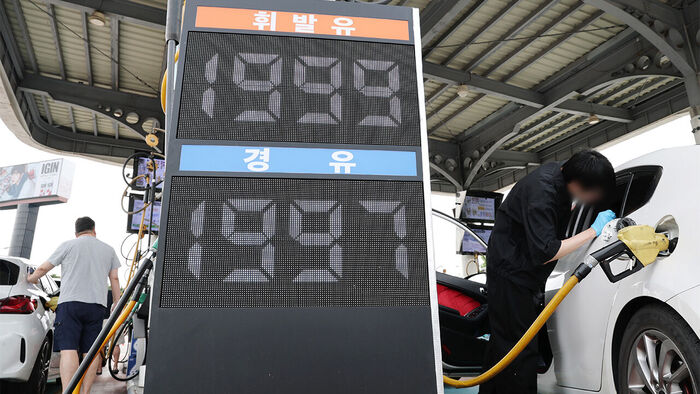
▲ Drivers fill up their vehicles at a gas station at the Mannam Rest Area in Seocho-gu, Seoul, on June 14, as the weekly average price of gasoline and diesel at domestic gas stations has shown a slight decline for four consecutive weeks.
As the Strait of Hormuz is expected to reopen soon following the end of the conflict between the U.S.-Israel and Iran, attention is focused on how quickly domestic fuel prices will fall.
While the reopening of the strait—which had caused bottlenecks in the international crude oil market—may ease pressure for further price surges, it is expected to take some time for prices to return to pre-war levels due to the time lag in reflecting international oil prices in the domestic market.
According to Opinet, the Korea National Oil Corporation’s fuel price information system, and industry sources today (June 15), the average retail price of gasoline at gas stations nationwide for the second week of June (June 7–11) was 2,009.9 won per liter, down 0.5 won from the previous week.
The price of diesel fell by 0.3 won to 2,004.8 won.
Fuel prices, which surged following the outbreak of the Middle East war, saw gasoline prices exceed 2,010 won in early May. However, they have been hovering in the 2,000-won range, showing a slight decline for four consecutive weeks as the possibility of an end to the war has increased.
Amid this situation, there are observations that international oil prices will face downward pressure once the Middle East war, which triggered the price surge, effectively comes to an end and the Strait of Hormuz is reopened.
South Korea is highly dependent on the Middle East for its crude oil, with about 70% of its imports coming from the region last year, making it sensitive to variables involving the Middle East and the Strait of Hormuz.
The reopening of the Strait of Hormuz could act as a factor for further fuel price declines as international shipping rates and insurance premiums stabilize.
An industry official said, "Both sides appear to have agreed to manage the situation stably," adding, "This could serve as a psychological stabilizing factor for the international crude oil market."
However, expectations are that it will take a considerable amount of time for domestic consumers to feel the impact, even if international oil prices stabilize.
This is due to the time lag, a structural characteristic of how domestic fuel prices are determined.
It typically takes 2 to 3 weeks for international oil prices to be reflected in domestic prices, as a result of complex factors including the time required for maritime transport after crude oil is imported, the refining and distribution period by oil companies, and inventory turnover cycles.
A bigger variable is whether this peace agreement will be upheld.
The current situation in the Middle East is such that tensions could be reignited at any time by accidental clashes.
Industry analysts note that for oil companies, which have been diversifying their import sources for nearly four months since the war began, the costs and risks are too high to immediately increase imports of Middle Eastern crude oil based solely on this agreement.
An industry official stated, "We cannot say the strait is safe yet," adding, "For the time being, we will have to watch whether the agreement is well-implemented."
Even if the crisis ends, it is projected that it will take several more months for a complete normalization, including the maintenance of crude oil production and transport infrastructure, the removal of mines in the strait, and the passage of an estimated 1,000 to 2,000 vessels currently waiting in the area.
Furthermore, the won-dollar exchange rate, which has recently solidified in the 1,500-won range, is expected to offset the downward pressure on international oil prices by increasing the cost of crude oil imports.
An industry official said, "Even when the strait was temporarily opened in April, the decline in international oil prices was smaller than expected," adding, "International oil prices, which are still fluctuating around 90 dollars, will need to see a definitive end to the war, rather than just a truce, to face further downward pressure."
(Photo: Yonhap News)
※ Please note: This article was translated by AI and may contain errors.