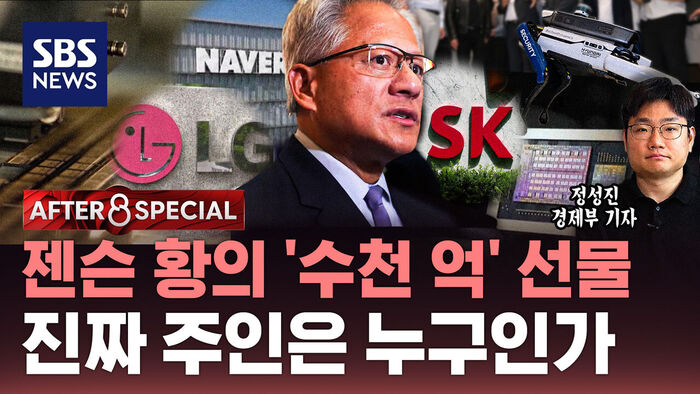
Do you know who the most talked-about person in South Korea has been recently? It is Nvidia CEO Jensen Huang, who visited South Korea on June 5. Greeting the country by saying he brought a surprise gift, Huang literally made a whirlwind of moves during his five-day stay. As soon as he got off the plane, he rushed to an internet cafe (PC bang) to meet e-sports legend Faker. He also had a so-called "brotherly meeting" over pork belly and soju with SK Chairman Chey Tae-won, LG Chairman Koo Kwang-mo, and Naver Founder Hae-jin Lee. He even appeared on an entertainment show and threw the ceremonial first pitch at a baseball game. On the final leg of his trip, he visited major Korean companies one after another to strengthen AI alliances and announced cooperation plans in areas such as AI factories and physical AI. He emphasized that he brought potential business worth hundreds of billions of dollars, calling it the largest business gift in South Korean history. Let's unpack the bundle of gifts Jensen Huang left behind.
1. Jensen Huang Emphasizes the 'AI Factory' Business
The aspect he emphasized the most during this visit was the "AI Factory" business.
[Jensen Huang / Nvidia CEO: Building AI factories is very important. If it is profitable, anyone would want more AI factories.]
An AI factory is a next-generation data center for AI. Going beyond traditional data centers that merely act as storage for vast amounts of data, it utilizes this data for AI learning and inference, ultimately producing customized AI to be used in physical systems such as robots and autonomous vehicles. Huang defines AI factories as essential infrastructure for the AI era and views them as Nvidia's current and future bread and butter. Why, then, did he bring the AI factory business to South Korea? It is because South Korea is the optimal location to build and operate AI factories. First, AI factories require semiconductors capable of processing massive amounts of power and data. Telecommunications networks are also crucial for fast data processing, and cloud services are needed so that various companies can utilize these AI factories. Ultimately, there must be industries where the customized AI created in these factories can be applied. That industry is physical AI. Various forms of physical AI are expected to take root in robotics, mobility, and manufacturing as a whole, and South Korea is a country with an exceptionally rich manufacturing sector where physical AI can thrive. This is evident from the companies Huang met during his visit. SK leads in semiconductors and telecommunications, LG in robotics and data center technology, Hyundai Motor in robotics and mobility, and Naver in cloud services—all of which are leading industries essential for AI factories. Doosan, where Huang threw the first pitch, is also a key player in the AI factory alliance through cooperation in power sectors, including physical AI and small modular reactors (SMRs).
[Jensen Huang / Nvidia CEO: From robotics to future AI factories, we are cooperating as one giant team.]
2. A Multi-Billion-Dollar Gift: Is It Real?
So, is the AI factory industry truly a surprise gift? First of all, yes, it is a gift. Simply having the opportunity to cooperate on future growth engines with Nvidia, the absolute leader of the AI era, is a massive opportunity. South Korean companies will handle key processes for AI factories and may receive priority supplies of Nvidia's GPUs. However, this gift is actually more precious to Jensen Huang and Nvidia itself. Ultimately, Nvidia's GPUs are essential for AI factories. At a time when U.S. big tech companies like Google, Microsoft, and Meta are accelerating the development of their own chips to reduce their reliance on Nvidia, this secures a stable revenue stream for Nvidia. By proposing to build AI factories together, Nvidia has essentially secured future buyers for its GPUs. While it was touted as a gift worth hundreds of billions of dollars, the largest share of the fruits goes to Huang himself. Still, up to this point, it can be seen as a win-win. The concerning part comes next.
[Jensen Huang / Nvidia CEO: Nvidia's greatest contribution to South Korea is inventing the AI industry and creating the AI ecosystem.]
3. "Complete Dominance of the AI Ecosystem"
What Jensen Huang is aiming for is Nvidia's complete dominance of the AI ecosystem. The secret behind Nvidia becoming the world's top company is its ecosystem strategy. Until recently, Nvidia's GPUs and AI chips have been irreplaceable, ensuring that the development of the AI industry directly translates into Nvidia's growth.
[Chang Young-jae / Chair Professor at KAIST: The background of Nvidia's growth lies in such an ecosystem strategy, and they are trying to create their own ecosystem in physical AI as well, ultimately aiming to lock us in.]
With competition in AI chips intensifying, Nvidia is preparing another ecosystem strategy, this time in physical AI. The goal is to preemptively secure AI models to be used in robotics and mobility. To achieve this, data on robots and mobility used in various real-world fields is key. The entities that can provide this data are South Korean companies. By partnering with South Korean physical AI companies, Nvidia aims to train and develop actual models, with the ultimate goal of making Nvidia the standard model for physical AI—such as robotics and mobility—just like Windows for PCs or Android for smartphones. While this is an opportunity for South Korean companies to grow together through cooperation with Nvidia, a leader in AI technology, there is also a clear risk of becoming dependent on Nvidia's ecosystem.
4. "A Two-Track Strategy Is Needed"
A two-track strategy is necessary. While gaining what we can from Nvidia, we must also bolster our own independent research and development, including our own models, to avoid dependency. The day after Jensen Huang left, the South Korean government announced that it would embark on developing independent physical AI technologies. It appears that both the government and businesses must not miss this critical window. Although CEO Jensen Huang brought a bundle of gifts to South Korea, we must not forget that behind his friendly image lie Nvidia's economic interests and a fierce survival strategy.
(Reported by Jeong Seong-jin | Written by Shin Hee-sook | Camera by Cho Chang-hyeon | Video by Hong Jin-young | Graphics by Yang Hye-min | Produced by SBS Digital News)
※ Please note: This article was translated by AI and may contain errors.
Jensen Huang's Multi-Billion-Dollar Gift: Who Is the Real Beneficiary?
Jun 15, 2026