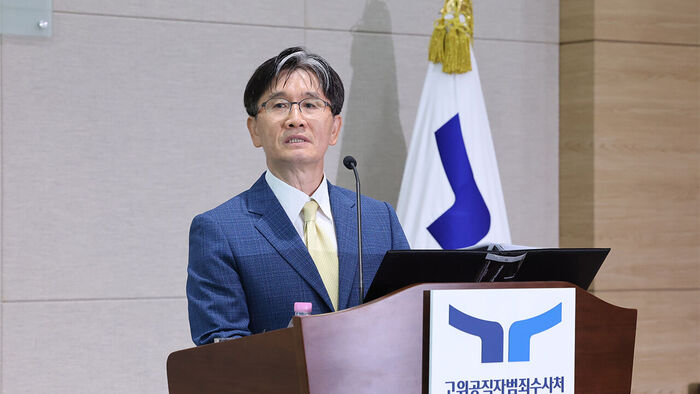
▲ Oh Dong-woon, Chief of the Corruption Investigation Office for High-ranking Officials (CIO), speaks during a press conference held at the Government Complex Gwacheon on the 15th.
Oh Dong-woon, Chief of the Corruption Investigation Office for High-ranking Officials (CIO), emphasized that "revisions to the CIO Act are essential to overcome limitations in personnel and structural shortcomings."
During a press conference held this morning (June 15) to mark his second anniversary in office, Chief Oh stated, "Legal revisions are necessary to continue the investigations without sanctuary that the public desires."
Chief Oh assessed the past year, saying, "The past year has been a breathless time, as we have run without a single day of rest since finishing the investigation into the insurrection case, which left a major mark on our constitutional history." He added, "Based on the potential that allowed us to complete such a massive historical case, we have achieved results such as the indictment of the Jeonju District Court judge bribery case, which recently shook judicial trust, and the sentencing of heavy penalties in the police superintendent-general bribery case."
He continued, "Every member of the CIO has been repeating relentless innovation to take a leap forward at the forefront of eradicating corruption among high-ranking officials in the Republic of Korea," and explained, "We have moved dynamically to advance our investigative capabilities and have built a solid foundation that remains unshaken by living power or external pressure."
Chief Oh emphasized that to fully exert the CIO's investigative capabilities, it is necessary to increase investigative personnel and amend the law to align the scope of investigation with the scope of indictment.
Under current law, the authorized personnel for the CIO is set at 25 prosecutors, 40 investigators, and 20 administrative staff.
The CIO believes that at least double the current personnel in each category is required to perform its duties normally.
While the CIO has the authority to investigate crimes by high-ranking officials, it can only directly indict judges, prosecutors, and police officers of the rank of superintendent-general or higher.
For other cases, if it determines that an indictment is necessary, it can only request the prosecution to file charges.
Chief Oh urged, "The legal revision is not about expanding the agency's power, but a desperate plea to sharpen the blade against the great evils rooted throughout our society," adding, "Please listen to the urgency of the legal revision for the realization of judicial justice and join forces."
Furthermore, he stated, "We are currently facing a major transformation of the judicial system with the establishment of the Serious Crimes Investigation Agency and the Public Prosecution Service," and added, "In times of upheaval, we will fulfill our role as a leader and a solid breakwater in the national anti-corruption investigation landscape."
(Photo: Yonhap News)
※ Please note: This article was translated by AI and may contain errors.