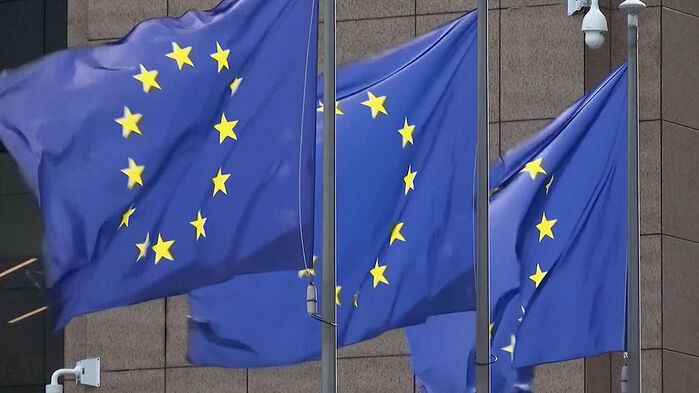
▲ European Union
The international community has welcomed the agreement between the United States and Iran on June 14 (local time) to sign a memorandum of understanding (MOU) aimed at ending the war.
UN Secretary-General Antonio Guterres, in a welcoming statement, described the peace agreement as a "significant step forward" toward resolving the war in the Middle East.
Guterres expressed gratitude to the mediating countries, including Pakistan, Turkiye, and Saudi Arabia, saying, "I hope the parties will build on this new momentum to redouble their efforts toward a final resolution of the conflict."
Antonio Costa, President of the European Council, wrote on X (formerly Twitter), "I welcome the agreement between the United States and Iran," adding, "I look forward to this agreement bringing an end to the war that has caused immense sacrifice, and to the full restoration of freedom of navigation in the Strait of Hormuz."
Under the MOU to be signed by the U.S. and Iran, the Strait of Hormuz will be opened first, while difficult issues such as Iran's denuclearization and the lifting of sanctions on Iran will be discussed during an additional negotiation period.
European nations also released welcoming statements one after another, calling for the swift finalization and implementation of the details of the nuclear agreement.
The leaders of the United Kingdom, France, Germany, and Italy said in a joint statement, "We sincerely welcome the announcement of the MOU between the United States and Iran," adding, "Iran must never acquire nuclear weapons, and we stand ready to work with the U.S., Iran, and the International Atomic Energy Agency (IAEA) to this end."
These countries emphasized that they are prepared to lift sanctions on Iran if Iran takes action regarding its nuclear program.
British Prime Minister Keir Starmer emphasized in a separate statement, "For peace to last, it is essential that the commitments made, particularly regarding Iran's nuclear program, are robust, verifiable, and fully implemented," adding, "It remains the UK's firm and long-standing position that Iran must never possess nuclear weapons."
He continued, "We must now focus on faithfully implementing the MOU to ensure that the Strait of Hormuz remains fully and permanently open, and that the details of the nuclear agreement are finalized."
French President Emmanuel Macron also announced that leaders of the Group of Seven (G7) will discuss the long-term reopening of the Strait of Hormuz on June 16.
In a video posted on Instagram on the same day, Macron said, "G7 leaders will discuss the repercussions of this agreement, support for Lebanon, ways to ensure the continuous reopening of the Strait of Hormuz, and a final agreement on Iran's nuclear and ballistic missile activities."
Starmer also stated that once the conflict is suspended, a UK- and France-led support mission to clear mines in the Strait of Hormuz will be launched.
He said, "We make it clear that toll-free freedom of navigation in the Strait of Hormuz must now be restored," adding, "This is to alleviate the severe economic blow that families in the UK and around the world have suffered for months."
Japanese Prime Minister Sanae Takaichi also expressed her welcome and called for securing free and safe navigation in the Strait of Hormuz.
Takaichi posted on X (formerly Twitter), saying, "The end-of-war agreement must be realized so that free and safe navigation in the Strait of Hormuz can be secured as soon as possible," adding, "At the same time, I strongly hope that a final agreement on Iran's nuclear issue, among others, will be reached quickly."
Israeli Prime Minister Benjamin Netanyahu, whose country carried out attacks on Iran alongside the U.S., has not yet released an official response.
However, discontent has erupted within Israeli political circles, with former Defense Minister Avigdor Lieberman calling it a "catastrophe" and former Prime Minister Yair Lapid describing it as "one of the most shocking failures of Israeli foreign and security policy," the New York Times (NYT) reported.
※ Please note: This article was translated by AI and may contain errors.