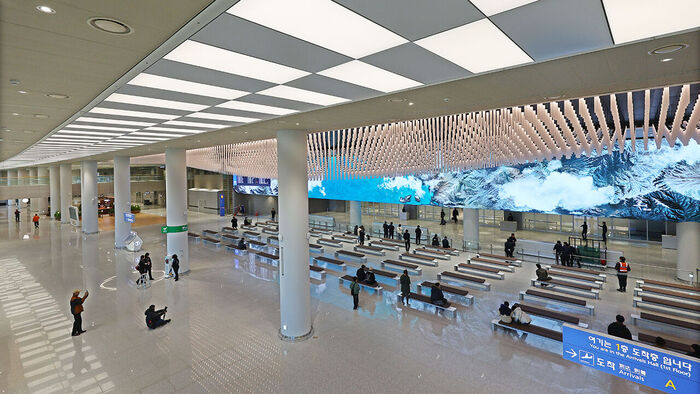
▲ The expanded area of Incheon Airport's Terminal 2 in 2024
An audit by the Board of Audit and Inspection (BAI) has revealed that the Incheon International Airport Corporation (IIAC) neglected the seismic performance management of some airport facilities and undercharged more than 150 billion won in rent for commercial facilities at Terminal 2.
According to the results of a periodic audit of the IIAC released by the BAI on Monday (June 15), the corporation failed to evaluate whether 142 out of 212 existing airport facilities met current seismic standards for up to 25 years after their completion, solely on the grounds that they had been designed to resist earthquakes at the time of construction.
A preliminary evaluation of 23 airport facilities that are more than 20 years old, conducted by the BAI in cooperation with the Korea Authority of Land & Infrastructure Safety, revealed that 13 of them are at risk of total or partial collapse or severe damage in the event of a magnitude 6.1 to 6.5 earthquake.
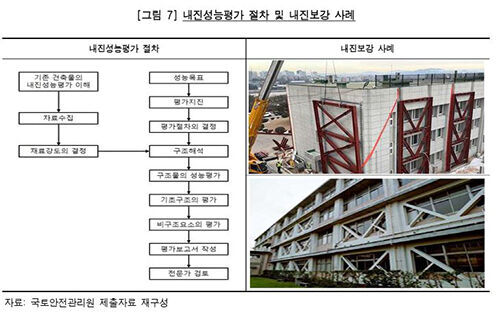
▲ Seismic performance evaluation process and seismic reinforcement examples
The BAI notified the IIAC to prepare measures to secure the seismic performance of the 13 facilities, establish and implement a systematic seismic performance evaluation plan for existing airport facilities, and take appropriate actions, such as reinforcement work, based on the results.
The audit also revealed that rent for commercial facilities at Terminal 2 was charged at a lower rate than originally contracted.
The IIAC charged commercial operators at Terminal 2 concession fees that were lower than the per-passenger rent specified in the original contract terms.
The BAI found that a total of 151.7 billion won in rent was undercharged for 11 stores run by eight operators over a 13-month period from December 2024 to January of this year. Additionally, the IIAC allowed three duty-free operators to pay the remainder of their rental deposits with guarantee insurance policies instead of cash, resulting in a loss of approximately 3.27 billion won in interest income over one year.
The BAI issued a cautionary warning, demanding that the IIAC handle related tasks thoroughly to prevent future undercharging of rent or omission of rental and interest income contrary to contract terms.
The management of the installation of backup batteries for emergency power was also found to be lax.
Between 2018 and 2023, the IIAC signed contracts worth 6.5 billion won for the purchase and installation of backup batteries for emergency power. However, it turned a blind eye to the fact that 4.3 billion won of this total was effectively subcontracted in its entirety to companies unregistered as electrical contractors.
Furthermore, the IIAC approved the completion of the project even though batteries that had not undergone Korean Industrial Standards (KS) inspections or lacked test reports were delivered and installed.
The BAI notified the IIAC to prepare measures such as filing complaints against the main contractors, restricting their bidding eligibility, and filing complaints against the subcontractors. It also demanded disciplinary action of at least a light warning for the officials who improperly handled contract management and completion approvals.
The investigation also revealed that economic feasibility reviews were insufficient during the process of developing and leasing land around the airport.
When developing and leasing land around the airport for hotels, entertainment, and office facilities, the IIAC set rental rates and lease periods without reviewing the economic feasibility, such as the nature or profitability of each facility.
The audit showed that for 12 out of 18 hotel, entertainment, and office facilities, the rental income fell short of the opportunity cost of leasing. Additionally, for six out of eight facilities contracted under the condition that the IIAC would demolish them, transferring ownership for free would have been economically more advantageous.
The BAI notified the IIAC to devise plans to improve land leasing methods by incorporating economic feasibility reviews, and issued a warning to thoroughly manage office facilities so they are operated in accordance with their original purposes.
(Photo: BAI, Yonhap News)
※ Please note: This article was translated by AI and may contain errors.