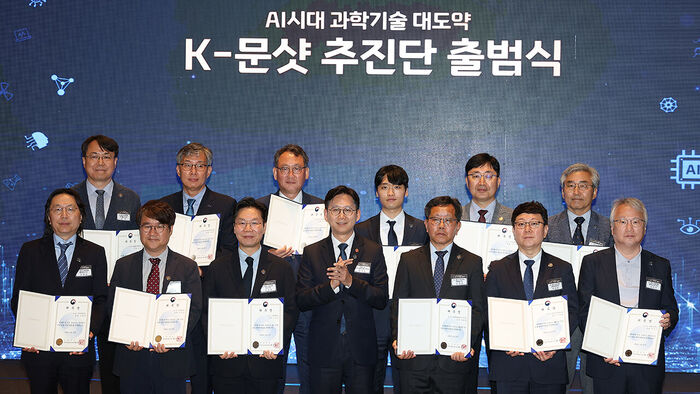
▲ Bae Kyung-hoon, Deputy Prime Minister and Minister of Science and ICT, poses for a commemorative photo with attendees at the 'K-Moonshot Launch Ceremony' held at Dragon City in Yongsan-gu, Seoul, on May 27.
Experts have suggested that Program Directors (PDs) must be granted budget authority and the power to modify projects to ensure the success of "K-Moonshot," a pan-government project aimed at solving scientific and technological challenges using artificial intelligence (AI).
The Science and Technology Policy Institute (STEPI) announced on June 15 that it has published a "Science and Technology Policy Brief" report, which argues that to succeed, the K-Moonshot project must shift its focus from merely selecting missions and tasks to advancing mission-oriented execution strategies.
K-Moonshot is a pan-government project designed to integrate AI into the field of science and technology, with the goal of doubling research productivity by 2030 and solving 12 national-level challenges by 2035.
Although the project is led by PDs—who are private-sector experts—there are concerns that the operational system and the scope of their authority remain ill-defined. Reports indicate that their influence over budget adjustments for related projects, excluding major ones, is limited to an advisory role.
The report proposes that the autonomy, accountability, and budgetary priority of PDs should be legally guaranteed through special legislation.
It suggests that PDs should be given control over mission-specific budget packages and priority access to platform resources, as well as the authority to suspend, integrate, or expand projects.
Furthermore, the report recommends that the government establish measures to secure budgetary priority for K-Moonshot and encourage the allocation of resources for K-Moonshot missions within budget formulation guidelines.
The report also highlights the need to pay attention to the U.S. "Genesis Mission," an AI-based scientific acceleration project, noting its ability to identify bottlenecks in scientific challenges and its short, six-month evaluation cycles for such challenges.
The report emphasized that rather than confirming and executing large-scale national projects with massive budgets all at once, a phased execution system—moving from initial verification to performance assessment and then to investment expansion—is more efficient. It urged the establishment of a unique execution method for K-Moonshot missions.
Additionally, the report added that the specific methods for utilizing AI in each mission should be detailed, and the development of common AI-based platforms should be actively pursued.
Hong Seong-joo, a senior research fellow at STEPI, stated, "The success or failure of K-Moonshot depends not just on 'what we will do,' but on 'how we will break through.' Advancing mission-oriented execution strategies is the key."
(Photo: Yonhap News)
※ Please note: This article was translated by AI and may contain errors.