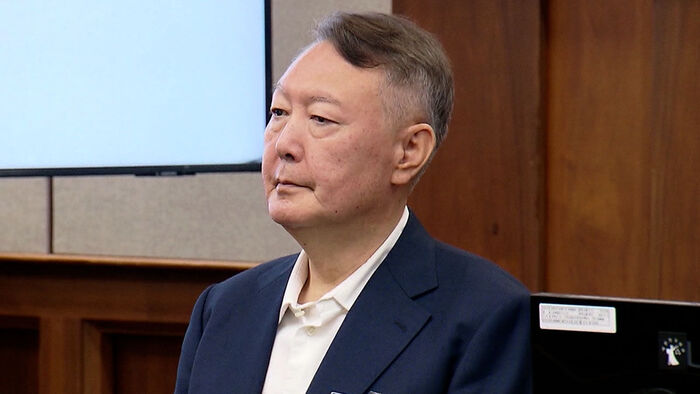
▲ Former President Yoon Suk-yeol
The second comprehensive special counsel team led by Kwon Chang-young, which is investigating the remaining allegations following the three major special investigations, is reviewing a plan to redefine the end point of the December 3 insurrection.
The special counsel team is examining whether the end point of the insurrection can be specified as December 14, 2024—when former President Yoon Suk-yeol's impeachment motion was passed by the National Assembly and his duties were suspended—rather than 4:30 a.m. on December 4, 2024, when the emergency martial law was lifted.
The special counsel team stated that it has secured various circumstantial evidence to support this.
Among the evidence is the gathering of legal advisors, including former Minister of the Interior and Safety Lee Sang-min, former Minister of Justice Park Sung-jae, former Minister of Government Legislation Lee Wan-kyu, and former Senior Presidential Secretary for Civil Affairs Kim Joo-hyun, at a safehouse in Samcheong-dong after the martial law was lifted. The special counsel team suspects they discussed ways to justify the martial law and subsequent responses at the time.
The special counsel team also regarded the National Security Office and the National Intelligence Service's delivery of messages justifying the martial law to allies, including the United States, under Yoon's instructions after the martial law declaration, as participation in the insurrection. Consequently, they booked former National Security Advisor Shin Won-sik, former First Deputy Director of the National Security Office Kim Tae-hyo, former NIS Director Cho Tae-yong, and former First Deputy NIS Director Hong Jang-won on charges of performing key duties in an insurrection.
The special counsel team previously requested an arrest warrant for former KTV Director Lee Eun-woo on charges of promoting the insurrection, including intensively broadcasting news asserting the legitimacy of the martial law from immediately after its declaration until December 13, 2024.
The special counsel team also redefined the preparation period for the martial law to around November 2023.
During the investigation of former Joint Chiefs of Staff Chairman Kim Myung-soo and others, the special counsel team obtained testimony that Yoon asked, "Can you do whatever I tell you to do?" during a meeting at his official residence in November 2023.
The special counsel team views Yoon's remarks as preliminary work to win over military leadership in the process of preparing to declare martial law.
If the preparation period for the insurrection is moved forward and the end point is delayed as the special counsel team argues, the number of suspects to whom insurrection-related charges, such as performing key duties in an insurrection, can be applied is expected to increase.
In the courts, rulings on the preparation period for the emergency martial law vary across different judicial panels.
Previously, the special counsel team led by Cho Eun-seok, which investigated allegations of insurrection and treason related to the emergency martial law, concluded that Yoon and others had conspired to declare martial law "before October 2023," based on a notebook belonging to former Defense Intelligence Command chief Noh Sang-won.
However, the court of first instance rejected the evidentiary value of Noh's notebook, citing reasons such as the inability to determine when it was written, and ruled that Yoon decided to declare martial law somewhat impulsively on December 1, two days before the declaration.
The court of first instance in the "Pyongyang drone suspicion" case acknowledged that Yoon prepared drone operations around September 2024 to create the conditions and justification for declaring emergency martial law.
This moves the martial law preparation period forward by two months compared to the ruling of the first-instance court in the main insurrection case, leading to speculation that it could affect the appellate trial of the main case.
If the special prosecution team extends the end point of the insurrection beyond the lifting of martial law, controversy is expected to follow.
This is because opinions may differ on whether insurrectionist acts can be considered to have continued after December 4, given that the crime of insurrection requires instigating a "riot" with the purpose of "disrupting the constitutional order."
Previously, the Supreme Court ruled that 1981, when the emergency martial law was lifted, was the end point of the insurrection in the "May 17 insurrection case" led by former Presidents Chun Doo-hwan and Roh Tae-woo.
※ Please note: This article was translated by AI and may contain errors.