[Anchor]
Over the past three years, 366 people have had their names publicly disclosed for failing to pay child support after separating from their spouses. The total amount of unpaid child support has reached 17.3 billion won. While there are systems in place for victims who have not received support, there are loopholes everywhere.
Reporter Jo Yoon-ha examines what needs to be improved.
[Reporter]
One of the primary tools available when child support is not paid is the application for a direct payment order.
This is a system where you request that the former spouse's employer automatically deduct child support from their monthly salary.
Is it being applied effectively?
Three years ago, a person named Jeong, who divorced their spouse, had not received 70 million won in child support for over two years.
Jeong applied for a direct payment order against the ex-husband's company and received child support for a few months, but it suddenly stopped one day.
This was because the ex-husband had quit his job and started a one-person company.
[Jeong / Victim of unpaid child support: (The HR team) said, 'It won't be paid starting next month. This person has resigned.' I was devastated because it stopped after only two months of payments.]
If a person quits and moves to a new company, it is difficult to find out where they are working, and even if you do, you have to go through the entire direct payment order application process from the beginning.
[Seo Soo-min / Lawyer: In countries like the United States, there is an automatic succession system, so even if someone quits and moves to a new company, the new company is required to take over the obligation...]
Furthermore, in the case of a one-person company where the individual is the representative, there is no clear way to force the deduction if they refuse to pay.
Jeong also previously applied for what is called an "enforcement order."
This is a system where you ask the court to issue an additional order to "pay child support" in accordance with the original ruling.
Is this effective?
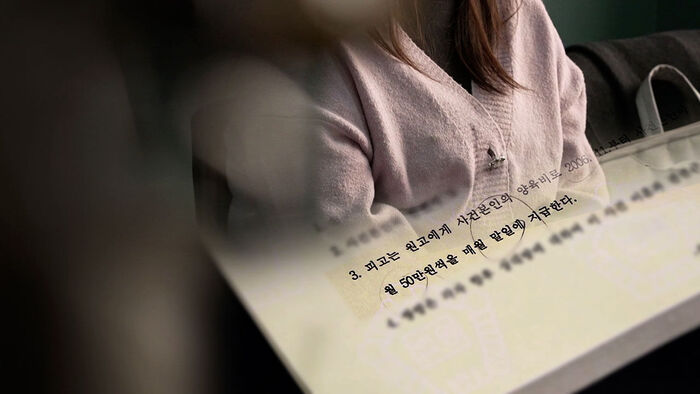
Kim Do-yeon, who divorced in 2006, has not received the 500,000 won in monthly child support for 20 years.
The ex-husband did not comply even after receiving the court's enforcement order.
Although Kim obtained a court decision for a 10-day "detention" to lock the ex-husband in a detention center, he managed to evade even that.
He avoided "service of process," the procedure for receiving court documents, by changing his address. Under current law, if service is avoided for six months, the detention order becomes null and void.
[Kim Do-yeon / Victim of unpaid child support: It's the same as saying, 'I can't receive the 10-day (detention), I just won't take it.' When an address is canceled, it literally says 'address canceled.' I still check (the address documents) once a month.]
While it is possible to impose a fine of up to 10 million won for ignoring a court's enforcement order, the fine is rarely imposed if the person simply promises to "pay child support in the future." In some cases, people choose to pay the fine because it is cheaper than the child support itself.
As a result, the number of people who evade child support payments by dodging the law has not decreased.
Unpaid child support over the past three years has reached 17.3 billion won.
Reported by Jo Yoon-ha | Video by Bae Moon-san | Video Editing by Park Na-young | Graphics by Seo Seung-hyun | VJ by Shin So-young
※ Please note: This article was translated by AI and may contain errors.
"Don't Want to Pay Child Support?" Dodging Tactics and Loopholes
By Jo Yoon-ha | Jun 15, 2026